Saturday, June 16, 2018

What we don't always see....


What we don’t always see…

My parents married in 1959 when both were 42 years of age. My father, a gregarious, fun-loving, social butterfly of a man, had been widowed just a few years before; his first wife had died of cancer. My mother was a quiet school teacher who kept to herself, teaching in a community not far from where she’d grown up just outside of Mobile. They met at church, and, albeit an unlikely pair, had decided to marry after a two-year courtship.

There was much that my father didn’t know about my mother. She suffered from schizophrenia, and what he might have chalked up to eccentricities was far more than that. The “thing” about which no one in her family spoke was her paranoia about absolutely everything – and which ultimately severed her relationships from family, church members and neighbors. From what her sisters and aunt described of her wedding day, my mother suffered a full-blown anxiety attack, and she and my father didn’t share the same household for months after their marriage because she simply couldn’t bring herself to share a home with this man who was now her husband.

But time passed, and my father was patient. Later that year, he planned a honeymoon that would take them through Georgia, South and North Carolina and into Virginia, allowing my mother to travel outside of the state of Alabama for the very first time in her life. The Negro Motorist book was their guide for accommodations as they made their way. It became slow progress, but eventually, my mother was able to let go of enough of her fears to be able to share a home with her husband.

Life was never normal. My mother’s fear and paranoia led to inexplicable behavior that defined our life and left others more than whispering behind our backs. Reading and music became my best friends, literally transporting me from our sad home to another place. My father was not so lucky: He learned to cope, but through working multiple jobs and drinking far too much. But he managed to keep his own sanity, always provided for his family, and, until death did them part 48 years later, remained in a marriage from which some men might have fled in the first few days, and certainly within the first few months.

There was a lot for which I never gave my father credit when I was growing up; I kept thinking that things could have been so much better if he could just have been home more, if he could just have been with me more. It took far too long for me to truly begin to understand that, during a time when it was even more difficult than it is today to get help for a loved one who is suffering from mental illness, he had done the absolute best that he could under enormously trying circumstances. And I began to understand, too, just how much he had given up of the life he once knew for my mother and for me.

And so, Dad, here’s to you, for remaining faithful, for dutifully serving your country, for always maintaining (and teaching me) your exemplary work ethic, and for never failing to believe that God would take care of you even in what appeared to be an impossible situation. Here's to you for all of the times that, wallowing in my own self-pity, I failed to recognize what you endured and sacrificed in order for me to have a roof over my head, clothes on my back, and food to eat. Here's to you for the pride that you took in everything that I accomplished. I hope that you’re enjoying a slice or two of the apple pie that you loved so much, with a big, strong cup of black coffee.

And for everyone who – like me – sometimes has trouble catching a glimpse of the magnificence of the forest through all of the thicket of trees, here’s to you, too, hoping that you’ll take time today, and every day, to consider the difficult choices made, and difficult paths traveled, by those we have yet to come to know and fail to appreciate as much as we should.

And for everyone whose life is impacted in any way by mental illness, please know that you are not alone. You are loved, especially by our Creator God. Please talk to someone, and please try to find resources to help you in the journey.

Saturday, October 14, 2017

Thoughts on Rick Bragg's "The Best of Who We Are":         Not only with our lips, but in our lives... 

Little children, let us love, not in word or speech, but in truth and action. 1 John 3:18


So, here’s my confession: I’ve never read any of Rick Bragg’s books. I’ve definitely come across – and thoroughly enjoyed – some of his humorous essays about life in the South from time to time.

Rick Bragg and I share a home state – Alabama. And although he is a few years older than I am, we are, for all practical matters, contemporaries.

Yet, no doubt, the lens through which we see life in the South is entirely different, shaped by the very different experiences that we each have had – him, as a white man, and me as an African American woman.

Several friends had suggested that I read his essay, “The Best of Who We Are,” in the October 2017 issue of Southern Living, so I genuinely looked forward to reading this piece.

The essay is a bit different than others of his essays. As he points out himself, he’s not one to write about news or politics – usually just the humor of everyday living in the South. But in this essay, Bragg took on the recent protest in Charlottesville, explaining that Southerners should be “angry to be dragged down among” the likes of the protesters because, he says, that really isn’t who we are. Or, at least, it isn’t the best of who we are.

The best of who we are, Bragg reminisced, was in the sermons that he heard in a tiny, all-white Baptist church in Alabama. There, he commented, ministers preached about “loving your brother and sister... [and helping] the sick and poor.” Those good lessons had followed him throughout his life.

While Rick Bragg was hearing words about loving his neighbor in his tiny, all-white church, elsewhere in the state of Alabama, I, too, was listening to a message of love at my great-aunt’s Methodist church. Rev. Raymond Stephens reminded a church filled with Black people that – despite the many negative messages that we received in the world – we, too, were loved by God, and equal in the eyes of God to anyone else. His sermon celebrating the Emancipation Proclamation as the exodus from slavery in our country was one of the most powerful messages that I heard as a child. Rev. Stephens’ messages of God’s limitless love were powerful and inspirational.

I would guess that many Southerners of Bragg’s and my generation heard our fair share of good messages of love in our churches. But did we really hear and digest those messages? How did the Christians in Alabama and elsewhere who used the Bible to justify slavery and segregation understand those messages? How did the Christian folks who stood at church doors and a governor who stood at university doors, refusing to allow people of color to come in, internalize those messages? Were the eight Alabama ministers who, in an open letter to Birmingham residents, criticized Rev. Dr. Martin Luther King, Jr., and argued that peaceful protests against segregation in Birmingham were “unwise and untimely,” sharing those messages in their churches? Could those messages of love really have made their way to the people who were responsible for bombing Birmingham’s 16th Street Baptist Church on September 15, 1963, taking the lives of four innocent African American girls whose only crime had been going to church that Sunday morning?

I think that the moments that represent “the best of who we are” aren’t the moments that come during good sermons, but instead are the moments that come after – when, with transformed hearts and lives, we try to apply those lessons of God’s love and mercy to the most difficult of life’s circumstances. The best of who we are or can ever hope to be will come in the moments that we stand together, hand in hand, supporting one another and fighting for justice for all of God’s people. We’ve seen glimmers of that light, in Dallas and Houston, in Wichita, in Charleston, when men and women, white and Black, Latino and Asian, have come together to work through grief, frustration and sadness. Those are the moments that give me the greatest hope.

I wish that more people had experienced the sermons of Rick Bragg’s minister and Rev. Raymond Stephens; the world would be a better place if those lessons of love touched every heart.

But only in moving beyond mere words will we see “the best of who we are.” If we all begin sowing those seeds of love that came to us in those great sermons, we can bring forth harvests that choke out hate – and we can live together in peace, support one another, and promote justice for all human beings.

Sunday, September 24, 2017

The Debate About Historical Markers, Monuments and Statues: Are Learning and Dialogue Possible?


Image result for statue of j marion sims in alabama
Image credit: EastHarlem.com


Several months ago, I stumbled across an essay about Dr. J. Marion Sims, often referred to as the "father" of modern gynecology. Sims has been credited with devising ground-breaking surgical procedures that greatly improved the lives of women in the 19th century.  Because of his work, statues of Sims can be found at the site of the New York Academy of Medicine, and in Montgomery, Alabama, where Sims lived and practiced medicine between 1845 and 1849.

And those statues are at the core of a controversy. Sims' critics claim that much of his experimentation was conducted on enslaved black women, and that many of his surgeries were performed without anesthesia; those critics argue that his statues should be removed because so much of his work was done at the expense of an enslaved and vulnerable population. Sims' proponents argue that we cannot place his work under our modern microscope to determine its ethics, claiming that he began performing life-saving procedures even before the use of anesthesia was considered safe, and that he performed his first pioneering surgeries, without anesthesia, on free and slave women, alike.

The controversy around Sims - a figure with whom I had not been at all acquainted - was eye-opening for me: The only reason that we were talking about Dr. Sims was because of these statues. But for these statues "honoring" Dr. Sims, none of us would be in dialogue about him, his work, and what we all might learn from that history.

And that gave me even more cause for pause than I already had about the removal of historical plaques, markers, and monuments in our communities. Would we still have reason to have open, critical, and revelatory conversations about the world that existed before our time if the name of every historical figure whose actions might offend our modern sensibilities was removed from our public spaces? More importantly, can we honestly believe that we can experience the kind of healing that is needed in our communities apart from our being able to engage in these kinds of honest conversations?

As a Christian minister, I try to put all of this into the context of what we learn in scripture: The fact that we are told in Genesis that Abraham took his slave woman, Hagar, and his firstborn son, Ishmael, into the wilderness and left them, presumably, to die, is not a reason for us to stop studying scriptures or to fail to recognize Abraham as a pillar of our faith tradition. The fact that we are told that Jacob's sons sold their brother, Joseph, into slavery out of jealousy is not a reason for us to stop studying scriptures, or to learn from "the rest of the story" that the sojourn of the people called Israel into Egypt (beginning with Joseph) likely saved them from famine and finally gave them a place in which Abraham's descendants could indeed grow to be as many as the stars in the sky. And while reading the account of Hagar's banishment, or the Genesis account of Joseph's brothers selling him into slavery, may make us uncomfortable, studying these texts should invite us - rather than judging our forebears under our modern microscope - to ask ourselves questions and to examine our own existence. What do we learn? When have we, too, displaced those in our own lives who are no longer useful to us? When have we, too, been willing to trade the life of a sister or brother made in the image and likeness of our Creator God for a few pieces of silver? Through these Biblical accounts, we are called to ask ourselves how God might call us to live differently.

So, as I ponder what we, in our modern culture, should consider in the debate about removing or renaming historical markers, monuments and statues, the same question arises for me: How might we be called to learn from the lives of these historical figures, and live differently in our own time?


And if we rename everything in our public space, what holds us accountable to one another to remember even the "ugly" of our history and learn from it?

Thursday, August 31, 2017

Who is Hattie McDaniel, and why should we care? The case against the Orpheum Theatre’s decision to remove “Gone with the Wind” from its Summer Film Series


Memphis’ Orpheum Theatre has announced its decision to pull the 1939 film, “Gone with the Wind,” from its summer film series.

I will not hide my disappointment at hearing this news. My disappointment centers around the fact that one of GWTW’s stars, Hattie McDaniel, was the very first African American to win an Academy Award, for her role as Mammy, a slave at Tara, the film’s fictional plantation. From my perspective, the Orpheum’s decision to pull GWTW has resulted in the loss of a significant piece of history – the history of Hattie McDaniel. And I am stunned that others have not voiced the same concern.

Through our modern lenses, some may choose to disparage this Civil War film. Some may choose to criticize McDaniel’s role as a slave in the film; it is claimed that she was criticized by the NAACP for accepting roles as maids and servants and perpetuating those stereotypes of African American persons.

But regardless of how we view it today, Hattie McDaniel made history.

McDaniel made history when a segregated Academy chose to honor her for her work. Consider that, among the other contenders for the Supporting Actress Oscar that year included McDaniel’s GWTW co-star, Olivia de Havilland. Imagine how she (and the rest of the contenders!) must have felt, losing to McDaniel – in 1940.

McDaniel made history when she accepted the award in a segregated Ambassador Hotel. The film’s producer, David Selznick, apparently had to secure permission for her even to enter the hotel to accept the award (She had previously been barred from GWTW’s Atlanta premiere.). In her acceptance speech, McDaniel, the daughter of two slaves, said, "I shall always hold it as a beacon for anything I may be able to do in the future. I sincerely hope I shall always be a credit to my race and to the motion picture industry."

McDaniel made history, even before her Oscar win, when she became the first African American woman to sing on the radio in the United States. And after her Oscar win, she went on to make more history, purchasing a home in the exclusive West Adams Heights neighborhood in Los Angeles, and in the process, fighting restrictive racial covenants which were designed to prevent African Americans from owning homes there.

Clearly, with our new, politically correct 20/20 vision in 2017, the Orpheum has decided not only that McDaniel isn’t a credit to her race, but also that the film – as art – has nothing to offer any of us. Too smart for our own good, we’ve thrown the proverbial baby out with the bath water. And instead of celebrating the extraordinary milestone of McDaniel’s win, we’ve pushed her out of sight and mind, her name never to be spoken by future generations who cannot fathom what she accomplished in her time. We choose to overlook just how incredible her performance must have been for a segregated Academy to award her an Oscar in 1940.

Another 24 years would pass before the next African American – Sidney Poitier – would win an Oscar for his role in “Lilies of the Field.”

I am ashamed that the Orpheum has chosen to close that chapter of history here in Memphis – rather than dedicating all future showings to McDaniel and taking that opportunity to share her history. I am ashamed that, rather than celebrating the fact that she pushed against restrictive racial covenants and helped to desegregate an exclusive Los Angeles neighborhood, we follow those who would find her an embarrassment, and push her aside.

Our shared history together – black and white – on North American soil is unpleasant and complicated. But it is just that: our shared history. And until we work to come to terms with it – in all of its ugliness – we will continue to struggle.

Thank you, Hattie McDaniel, for your contributions to our history. I, for one, truly appreciate you.

Monday, July 3, 2017

Who is my neighbor?

Who is my neighbor?


It was bound to happen.

I’ve tried to be so careful about walking with our dog since he’s become so sensitive to loud noises. Loud noises seem to paralyze him. He freezes where he is, refuses to move, begins shaking and wildly panting. Thunder, trash collection trucks, lawn mowers and blowers, and construction noises all seem to have the same impact. And that means that our walks are largely limited to evenings – after all of the noise except birds, bugs and other critters has gone away – and then he’s literally pulling me down the street, anxious to get out and enjoy his long-awaited walk.

So last night was bound to happen: We headed out for a brisk, long, winding walk through the neighborhood. As darkness fell on an otherwise quiet evening, the sound of fireworks in the distance sent our sweet dog into a panic. He froze, unwilling to budge, even to get out of the street.

The problem was that we were a few – four or five – blocks from home when he was spooked. We might as well have been four miles from home, given the fact that I can’t carry a spooked 65-pound dog. And, not having a cell phone with me (because I hadn’t anticipated fireworks on July 2!), I couldn’t call my husband to ask him to pick us up.

So there we were, mama and scared dog, quite literally stuck just minutes from our front door. And I hoped that someone else who had decided to take a late stroll might happen by.

Just a couple of minutes later, as I was still trying to comfort our dog, someone did walk by – a man I’ve seen almost every single day of the fourteen years that we’ve lived in the neighborhood, out on his daily walk. So I thought that surely he’d recognize me (or at least recognize our dog!) and I spoke to him, asking if he might happen to have a cell phone so that I could call my husband. He barked back (no pun intended), “What’s wrong with you?” I tried to explain quickly that my dog had been spooked by the fireworks and that we couldn’t make it home. And he quickened his pace as he walked by me, quipping, “Lady, you’ve got small problems.”

I can't argue with that; he was right. In the grand scheme of problems in the world, I had a small (first world) problem in my terrified 65-pound dog who refused to move. And in all fairness, it wasn't as if it were a life-threatening problem: Eventually, my husband would have wondered why we'd been gone so long and would have driven around to look for us.

But a couple was approaching from the opposite direction as the man rushed away. I called out to them. “Excuse me, by any chance would either of you have a cell phone? My dog got spooked…I need to call my husband.”

The first gentleman who passed me without stopping had now stopped and turned around in the street, watching to see if the other neighbors would come over to me. Was he stopping now because he might need to assist them, just in case my five-foot-two-inch self with my cowering, now slobbering dog, posed some danger? The couple stopped. They came over to me, introduced themselves, petted my frightened dog, shared a cell phone, offered to wait with me, and commented that they were glad that they had decided to take a late walk and were able to help. We hadn’t met before – but when I mentioned the block on which I lived, we talked about all of our common neighbors and friends. We talked, like neighbors meeting each other on the street. Today, I’m sending a thank-you note to my neighbors – and new friends – and I’m making a gift to their worshipping community in their honor.

No doubt, in this day and time, many of us would be leery of someone (yes, even a 5’2” non-athletic-looking me with a cowering dog) on the street asking for help. We might think twice, uncertain if it’s a trap or a scam.

I think that’s what Rev. Dr. Martin Luther King, Jr. meant when, in his retelling of the parable of the Good Samaritan, he commented that the priest and the Levite who passed by the injured man may only have considered what would have become of them if they stopped to help, while the Samaritan asked a different question: What would become of the injured man if he didn’t stop to help?

Who is my neighbor? Yes, my neighbor is the hungry neighbor with whom I can share a meal.

Yes, my neighbor is the neighbor without shelter, with whom my worshipping community can share hospitality through Room in the Inn.

Yes, my neighbor is the child in the failing school, where I and others can help read, tutor and provide a strong, mature, and loving presence.

Yes, my neighbor is the person looking for employment who I can connect with those who have jobs.

Yes, my neighbor is the refugee with whom I may share the far-too-many items in our home that we no longer need and use ourselves.

But, yes, my neighbor may be the person who lives just blocks away, whose gender, faith tradition, or skin color is not the same. That’s my neighbor, too.

Today, I am grateful for good neighbors who wondered what would become of me if they didn't stop. And today, I pray that I may always be that good neighbor.


Thursday, April 13, 2017

Holy Week Musings..."They will know we are Christians by our love..."


We began this Holy Week by remembering Jesus’ triumphal entry into Jerusalem - where the cheering crowds welcomed him, waving palm branches and strewing cloaks upon the road to honor the King. This King’s entry was humble - on a donkey, not like a warrior on a mighty steed. He had come in peace, in sharp contrast to the brewing furor of the religious authorities and the Roman Empire.

In no time, the tide would turn, and the adoring crowd would become an angry mob, demanding Christ’s crucifixion. And Jesus, who had come to serve, to heal, to give hope, to bring peace, would die a violent death on a cross in Jerusalem.

We are reminded of this stark contrast between the ways of Christ and the ways of the world in the events of the last several days. On Palm Sunday, in Alexandria and Tanta, Egypt, nearly four dozen Christians were killed in attacks in Coptic Churches, and over one hundred more were injured.  These attacks are the most recent in a six-month period during which more than seventy Christians have been killed in churches in Egypt while worshipping.

These attacks are a sobering start to Holy Week. For Christians who are privileged to worship largely without fear, we take for granted our ability to openly profess our faith. We take for granted our ability to raise our voices together in song and prayer in our churches.

But for those whose profession of the Christian faith is not without consequence - including the Christians in Egypt - the attacks become just another reminder that the decision to follow Jesus isn’t promised to be a safe one. The cost of discipleship is great. Jesus told his disciples, “’If any want to become my followers, let them deny themselves and take up their cross and follow me. For those who want to save their life will lose it, and those who lose their life for my sake will find it.’” (Matthew 16:24-25)  Jesus’ words can be hard words for us to hear - particularly for us in the Western world, where our relative freedom to express our faith may too often have lulled us into a false sense of both comfort and complacency - and silenced us in the face of injustice and oppression for which our voices should have been raised.

This Holy Week will bring our Lenten journey with a Jesus who was neither comfortable nor complacent to its close. And as we prepare our hearts for a joyful celebration of Easter, my prayer is that we do so remembering that, perhaps more than ever, our strong witness to our faith is needed in the world. The world needs to see in us the tremendous love that Christ has shown, in our actions, and in our standing in solidarity with those who suffer for our faith.
We are one in the Spirit, we are one in the Lord.
And we pray that our unity will one day be restored.
And they'll know we are Christians by our love, by our love,
yes, they’ll know we are Christians by our love.


In Christ,

Dorothy+

Wednesday, December 28, 2016

"Checking the box..."

Image result for checking the race box


When I was in high school, certainly not understanding the consequences of my actions, I "checked the box," identifying myself as black (The “label” wasn’t African American then…) when I took the PSAT (the preliminary SAT and qualifying test for the National Merit scholarship program).

I did well on the test, well enough, in fact, that my teachers expected that I would be entered into the National Merit Scholarship competition.  But instead I received a letter advising me that I had been entered into the National Achievement Program competition.  What is that, one might ask?  Well, that would be the National Merit Program recognition program solely for students of color.  

Some folks might call the National Achievement Program affirmation action at work, leveling the playing field for disadvantaged students.  But the "action" didn't feel very "affirmative" to me. With that one checked box, at age 14, I had a new definition of what it meant to be black in America: Separate, and clearly not equal.     

Soon thereafter, I read an essay by a black freshman at an Ivy League college, advising fellow black students not to “check the box.”  She, too, had made the mistake of checking the box when she had taken the SAT, and she had also had been entered into the National Achievement Scholarship Program, even though she had outperformed a white classmate who had been named a National Merit Scholarship winner.

From that experience, I learned what has been a valuable-for-me lesson: Never, never, never “check the box.”

When I took the SAT the following year, I didn't check the box. And as fate would allow, I got a second chance; my unwitting mistake from the PSAT didn't follow me.  This time around, I was entered into the National Merit Scholarship competition; later, I would be recognized as a National Merit Scholarship winner.  At least for that one moment, my worth had been determined not by the color of my skin, but by objective performance on a test.

I temporarily felt encouraged.

And so, as I began the college application process, I didn't check the box.  And as objectively as such things happen, with transcript, resume and National Merit ranking preceding me, I was invited in for scholarship interviews at all of the colleges to which I applied.

Of course, when I arrived for visits at these prospective colleges, it quickly became apparent to me that since I hadn't checked the box, and there hadn’t been any “dead giveaways” to the color of my skin, everyone assumed that I wasn't black - that is, until they saw me.  And I learned valuable-for-me lesson number two: Even the most loving and well-intentioned people who aren't black often carry around far too many stereotypes about people who are black that simply aren't true.

Case-in-point: When I applied to law school, I didn't check the box.  Without being the wiser, the law school chose to admit me solely on the objective basis of undergraduate grade point average (GPA) and law school admissions test (LSAT) scores.  I didn't realize at the time that the law school was still operating under a desegregation mandate; there was a mandatory quota for African American students for each year’s entering class.  So when I showed up, without having checked the box, I messed everything up.  In the law school's effort to increase retention among black students, we were automatically identified for additional course work in research and writing to improve our chances of success.  Everyone had been accounted for, except for me, and all of the names appeared on a list on the message board, with the date and time for the first of the mandatory sessions.  Since I hadn't checked the box, I wasn't on the list; but once the heads were counted, the folks in the law school admissions office who cared about the numbers realized that the numbers were off by one.

So, by the end of the first week, my name was added to the list, and the professor who was responsible for the study program hunted me down to inform me that my attendance was required at the next day’s mandatory study session. When I asked (nicely!) how I had come to be invited to this special study session, the professor muttered something about the law school's efforts to retain high-quality minority students.  Call me naïve, but what law school just assumes that all black students – regardless of their academic background or LSAT scores – are somehow in need of additional “help” in order to succeed? Clearly, the law school did not assume before identifying me as a black student that I needed additional coursework to help ensure my success. 

And so, I said no, for the same reasons that I hadn’t checked the box in the first place: I’d either make it – or I wouldn’t – on equal footing with other students. It may not have been the politically-correct course of action (Considering the number of phone calls that I received, I can only guess that no one in the law school's administration was happy with my decision.), but it was the only action that I could justify.


I don’t believe in “checking the box.” All of us should be greater than the sum of color labels that might be attributed to us. In my humble opinion, checking the box is a requirement that should be abolished in all academic admissions processes. There certainly must be better ways to ensure diversity and identify students who may need additional support in order to succeed. It is time for us to move toward judging one another by the content of our character – and not by the color of our skin.

Thursday, December 15, 2016

Help Wanted: Be the Light. Share the Light


A Christmas Eve from my childhood really stands out in my memory: I was maybe nine or ten years old when a mother of three young boys – the oldest of whom was about my age – was killed on Christmas Eve morning in my home town. She had stopped by a dry cleaner to pick up some cleaning, and as she was about to get in her own car to leave, the driver of another car lost control of her vehicle, and the mother was struck by the oncoming car as it plowed into the parking lot. Her three young sons were all in the car as this tragedy unfolded. The entire community was stunned by this family’s loss: Television shows were interrupted for a broadcast of the news, and even the news anchor was wiping away tears as he shared the story. We learned quickly that the family lived not far from us and worshipped at the Methodist church that was just a couple of blocks from our home.

For the next several days, I could think of little more than those young boys. Like Charlie Brown, in A Charlie Brown Christmas, I, too, was searching for the true meaning of Christmas at that point in my  life; I waited eagerly for the show to air each year, and watched it attentively, but even Linus’ impassioned speech still hadn’t helped me comprehend its meaning. And envisioning the sorrow in that nearby household left me at even more of a loss.

I finally asked my mother if I could take my allowance and buy the boys some cookies, just something to take to them to say that I was sorry for their loss, that lots of other kids were grieving with them, that even in the midst of all of the emptiness that they were experiencing, they were all still loved. My mother suggested that since we didn’t know the family, perhaps the best thing that we could do was pray; she felt certain that people who knew them had taken them more than they could use. I remember reading Luke’s account of the Christmas narrative before falling asleep, and offering prayers that the Christ Child would bring the best gift of all – healing – to the broken hearts of a grieving father and sons who were certainly expecting Christmas to be something very, very much different. My prayers, though, still didn’t feel like “enough.”

I’ve thought about those three young boys every year at Christmas. For them, and for others for whom Christmas may be a reminder of loss, it is especially important that the light of Christ be ever burning in our lives. Sharing that light of God’s promise of hope and love in a world in which there is far too much darkness is the best gift that we can offer to those who cannot see the light. Slowing down in the midst of the busyness of our lives to offer a smile, a hug, a phone call, a visit, a hand to hold, a word of encouragement, or time to share a prayer together – helps to remind us all of the One who came to dwell among us and bring healing and peace, and keeps the gift of the Light of Christ burning. 

Please look for every possible opportunity to share the light; and pass on the light that is shared with you. God is counting on us all.

Said the king to the people everywhere,
“Listen to what I say!
Pray for peace, people everywhere!
Listen to what I say!
The Child, the Child sleeping in the night,
He will bring us goodness and light!
He will bring us goodness and light!”
From “Do you hear what I hear?” (lyrics by Noël Regney)


Thursday, November 10, 2016


On Labor Day 2016, members of St. George’s, together with members of Germantown United Methodist, Germantown Presbyterian, New Bethel Baptist and Kingsway Christian Churches, gathered to prepare to go out on our third Labor of Love experience. As now has become our custom on those days, we greeted one another, and met neighbors that we’d not met before, and then we sat together for a time of reflection and prayer before our work in God’s world began.

It had been quite the summer:  From a massive earthquake in Italy, to devastating flooding in Louisiana, to an unprecedented killing in Orlando, to a lone Dallas gunman’s heartbreaking response to police shootings of several African American men in other cities around the country, the summer had been one to remember, but for all of the wrong reasons.

But even amid the sadness, rays of hope shone. Relief teams from throughout the world responded to Italy, to help locate survivors and provide aid. People who called themselves the “Cajun Navy” responded to neighbors in Louisiana, rescuing the stranded, preparing meals, providing shelter, and caring for one another as the reality of the number of people who were without homes settled in. People throughout the country responded to the Dallas mayor’s call for prayer for their city, and in communities like Wichita, police and civilians came together to begin to forge new relationships and break down barriers that had existed for far too long between them.

And so, on Labor Day, a couple of hundred Christians in Germantown came together, too, to show God’s light and love in a weary and tired Memphis community that needed to see that love. And we did it - neighbors coming together with other neighbors - with smiles and laughter, and grateful hearts. We delivered lots of meals, cleaned some yards, created 1,000 care packages for those among us who are displaced, and packed 10,000 meals for MidSouth Food Bank, through the MemphisFeeds Initiative. Coming together, we were able to accomplish more than either of our churches would have been able to accomplish alone.

Going forth into the world to serve God is what we are called to do. We are reminded of that pledge in our Baptismal Covenant, and we are literally sent forth each week when we leave the Lord’s Table.

But this year, our shared time of service seemed to take on new meaning, as we all searched for ways to make a difference when the needs were so great and the task before us almost seemed insurmountable. And we discovered yet again that while any one person’s hands are capable of doing mighty work for God, when we come together and work together, we accomplish so much more.

And so it is that we who are people of God are called to come together and work together, so that all of God’s people may know justice and peace. We must renew our commitment to serve God and God's people, and to break down the walls that separate us and work together for the good of all.

By now, we know that the work of breaking down barriers isn’t work that someone else can do for us. It is the work of the people, all of God’s people. The need could not be greater. The time could not be more imminent.

And so, my sisters and brothers in Christ here at St. George’s, we pledge to renew our commitment to make the world around us a better place by shining the light of Christ’s love, as it radiates from us, into the darkness. That’s the best response that we can possibly make to the world. And by shining God's light into the world, we continue to show just how relevant, and just how important, the Church continues to be. We can’t stop now. We can’t afford to be disheartened. We can’t love too much. God is counting on us all. And when we continue to shine the light of God from our little corner, and walk hand in hand with our neighbors, we will make a difference, one life at a time. 

In Christ,


Dorothy+

Wednesday, July 27, 2016

Your kingdom come...the words of Luke 11

"Your kingdom come" is not a passive prayer. Prayer changes us, and we in turn, change the world - and help bring about God's Kingdom. We invite you to hear this sermon on prayer.


Wednesday, June 15, 2016

Yet another mass killing: Can only our faith communities save us from ourselves? On loving more, and hating less...


I visited Auschwitz as a seventeen-year-old college freshman. To say that the experience was a powerful one for me would be a gross understatement. Seeing what remains of a camp in which over one million people were killed was gut-wrenching. It was impossible for my young mind to comprehend that any human beings could harbor such hatred and commit such acts of cruel violence against any other human beings. I could only imagine the suffering of those who were held in a place where the best conditions were not compatible with human life. It seemed that the smell of burning flesh still emanated from the crematorium.

Visiting Yad Vashem, the Holocaust Museum in Jerusalem, just two days ago brought all of the painful memories flooding back. The names Auschwitz-Birkenau, Belzec, Chelmno, Majdanek, Sobibor, and Treblinka – the six Nazi extermination camps in Poland – have become synonymous with massive death and suffering. I continue to wonder how any group of people could have justified the calculated killing of others made in the same image and likeness of God with seemingly no sense of concern or remorse for the taking of human lives.

As a seventeen-year-old, I really hadn’t connected the atrocities of the Holocaust with other horrid examples of “man’s inhumanity towards man”: the enslavement of Hebrews by the Egyptians; the enslavement of many during the Roman Empire; the participation in the African slave trade by Great Britain, a number of European countries, and ultimately, the United States; the killing of an estimated 10 million Congolese during the exploitative reign of Belgium’s King Leopold; and the genocide in Rwanda. Today, I look at all of these events along our historical continuum and surmise that our disregard for the value of other human life is astonishing.

And it seems that history repeats itself over and over again.

In our country today, it's not the names of death camps, but rather the names of communities like Columbine, Aurora, Newtown, Charleston, San Bernadino, and now, Orlando that have become linked with acts of violence and senseless loss of life. (A sad compilation of mass shootings in this country since 1982 can be found at http://time.com/4368615/orlando-mass-shootings-chart/.)

I suppose that if one sees another human being as less than human, it becomes much easier to make a decision to take another life.

I’ve said before that we can legislate lots of things, but we can’t legislate hearts. I truly believe today that what we need our government (executive, legislative or judicial branch) can't give us. What we need today can only be given by our faith communities being at work in the world, as an example of a better way of living, and encouraging us all to love more and hate less. If our faith communities aren’t opening their doors to invite in those who are lost, and if we who are inside aren’t stepping out, going about and showing love to those who need us, then it seems that our communities of faith serve no purpose at all. We need to make our presence felt in schools and offer children both help and hope. We need to provide food and shelter to the poor. We need to bring all of our resources to bear to help connect people to work, and to accessible care for physical and mental illness. But more than anything, we need to erase the lines that divide us into races, classes, ethnicities, “groups” and abilities, so that we all may look at one another as children made in the image and likeness of our creator God. We can’t leave to government the work that has truly been given to us who are part of faith communities to do.

It’s been quite some time since the song, “Wake up, Everybody,” (recorded by Harold Melvin and the Bluenotes, lyrics by John Whitehead, Gene McFadden and Victor Carstarphen) was a popular hit, but its message still rings true: It’s time for all of  our communities of faith to wake up, and get to work.

Wake up, everybody,
No more sleepin' in bed.
No more backward thinkin',
Time for thinkin' ahead.

The world has changed
So very much
From what it used to be
There is so much hatred
War and poverty.

The world won't get no better
If we just let it be.
The world won't get no better.
We gotta change it, yeah,
Just you and me.

Saturday, December 19, 2015

The house isn't decorated, the cards aren't mailed: Doing what really matters this Christmas...

 
The year that our older daughter was born, we joined neighbors for a Christmas celebration. Their home was so beautifully decorated, and I had serious Christmas-décor envy. Not a nook, not a cranny of their home was untouched by my friend’s very creative and talented hand.
 
A couple of years later, as we were preparing to have friends over for an Advent evening dinner, I asked my friend for her help in getting our house ready. I hauled out the bins of items that I had acquired through the years, and she brought a few more lovely items to add. In one evening, she had helped me transform our house into a showplace, from the Christmas trees, to the stairwell, to the mantle, to the chandeliers, to lovely centerpieces for the tables. And she had done it with such great ease, patiently guiding me through all of the steps that I needed to make it all happen on my own.
 
Faithfully, I recreated her beautiful work for a number of years after, always giving her the credit for helping me put it all together. But somewhere along the way, the hours that it took me to do it all seemed to escape. There were Birthday Parties for Baby Jesus at our house, and with the kids at Emmanuel Center - time spent trying to teach children the true meaning of the season. There were gifts to wrap for children at Emmanuel Center, who otherwise might not have gifts at Christmas, and meals-on-wheels to deliver to seniors. And, in more recent years, there were homebound parishioners to visit, and hands to hold.
 
Our house isn’t decorated. The cards haven’t been mailed. And the shopping? Well, no, that hasn’t been finished yet, either.
 
A piece of me wonders if I’ve let our daughters down. As they arrive home from college, it won’t be to a Southern Living decorated home or an extraordinarily decadent dessert.
 
But I hope, as they mature, their own Christmas to-do list will better mirror the one above, upon which I recently stumbled, than the one to which I aspired years ago. I hope that hours that might be filled with buying presents will instead be hours during which they will be present with those who need them. I hope that the attention that might otherwise be given to hanging decorations and lights will instead be attention given to being a light in lives that are filled with darkness. I do believe that, in the midst of very busy lives and too-often misplaced priorities, this modified to-do list is one which will serve us all better in these days to come.

Thursday, June 25, 2015

For this one moment, we can choose to love....


The pictures that I hoped I would see from Charleston, South Carolina last Sunday appeared – just as I hoped I would see them.

Emanuel AME Church was packed with worshippers. Men and women, black and white, these children of God were all singing and praying together.

For one day, one moment in time, God’s people were united in worship and prayer, and it was a beautiful sight.

My heart wishes that it hadn’t taken the loss of nine lives, the murders of nine innocent people, to make that moment in time happen.

The group had gathered for Bible Study, when a young stranger came among them. The pastor and church members welcomed him, and he apparently sat quietly in their midst for an hour, as they prayed and studied the Scriptures.

And then the young stranger opened fire, taking their lives.

We all want to believe that this kind of violence shouldn’t happen anywhere, but especially not in God’s house. We all want to believe that God’s house is, of all places, a place of peace and love, not hatred and violence. We all want to believe that a young man like the man accused of these murders could not, in such a short life, have learned such hatred.

Our collective hope has been shattered.

Yet what this young man may have intended for evil has created for God’s people everywhere a singular opportunity to choose to bring about great good.

Jesus tells us, “I give you a new commandment, that you love one another. Just as I have loved you, you also should love one another.” We are to love one another just as Jesus loved the man born blind and the lame man lying in despair, the leper and the demoniac, outcast from their communities, the hated tax collector and the Samaritan woman at the well. To love like Jesus loves means setting aside fears and misgivings about those who are different than we are – and to see the handprint of the Maker on all of God’s beloved children.

For this one moment in time, we can choose to love as Jesus loves. And when we do, we can expect great things to happen: Hatred cannot thrive when it is choked out by that much love.

Saturday, November 29, 2014

Some thoughts on Ferguson....and the fallacy of an absent God....


I have been silent throughout the Ferguson ordeal.

Truthfully, as I have been trying to process it all, I could come up with no words to express all of the feelings that I had: tremendous sadness for the loss of a young Black man who should have had much potential, uncertainty about so many never-to-be-answered questions, lingering doubts about whether justice could ever have been served, and great disappointment and heartbreak that, in the aftermath, a community had been left in ashes and devastation, with livelihoods threatened.

Two things drew me from my voicelessness.

The first was hearing someone (well, not just any someone, but a scholar of scriptures…) comment that God is frequently absent and that the Bible was filled with examples of God’s absence.

The second was seeing two extraordinarily bright and talented young male cousins on Thanksgiving Day – two amazing young Black boys who need to have amazing futures in this world.

Had the man who spoke of God’s absence not been a scholar of the scriptures, I might not have given his comment much thought. But he is, and his comment left me to do some honest reflection. I wondered just how many other people truly have come to believe, in the face of inexplicable heartbreak and disappointment, that God must be absent, uncaring and uninvolved in our struggles.

Surely Moses’ people must have wondered if God were absent as they spent 400 years laboring under Pharaoh’s oppression and violence – and while Egypt thrived as a result of their labor. Yet, God heard their cries, and raised up Moses to deliver them from their bondage. God was not absent.

Surely Hagar must have thought that God was absent when she and her son, Ishmael, were abandoned in the desert to die after they were no longer of any use to Abraham, Sarah and their young son, Isaac. Yet, God heard her cries, and renewed to her the promise that a great nation would be made of her son. God was not absent.

Surely the people called Israel must have thought that God was absent when long after the prophets foretold the coming of the Messiah, they labored under the oppression and violence of a Roman Empire that thrived in large part because of their suffering. Yet, God heard their cries, and sent God’s own Son, in flesh and blood, to live among them and to give his life for them. God was not absent.

And I have no reason to believe that God is absent now… not in Ferguson, Missouri, not in Memphis, Tennessee, not from black or white, oppressor or oppressed, poor or rich, tattooed or bow-tied, well-heeled or worn-down.

To be certain, God’s justice may not look like “our” version of justice; it may not come in “our” time, or be delivered as we would have it delivered. It may feel unsatisfactory to us that God loves all of God’s people unconditionally, when in our hearts we may crave retribution. It may feel unsettling to us to think that, to God, no human life is less valuable than any other human life.

But the God who implores us to love one another as we are loved is not absent.

God is not absent, when the cries of business owners in Ferguson are heard by compassionate residents who stand shoulder-to-shoulder to protect those businesses from those who would wreak havoc and destruction.

God is not absent, when the cries of a Ferguson woman who poured all that she had into a small bakery that was severely damaged in the looting are heard by generous people from across the country who give hundreds of thousands of dollars to help her rebuild.

God is not absent, when the cries of the manager of Ferguson’s only library are heard by supporters who generously offer what they can to help, so that the library may continue to be a place for learning, for community meetings and for resources for children and adults.

And God will not be absent, in the days, weeks and months to come, as those who have never before engaged in honest dialogue sit down together to better understand one another’s perspectives – and to learn how to live in community with one another in a new way.

I look in the faces of our two young cousins with hope and expectation, that the world in which they grow up and live as adults will be an even greater reflection of God’s abiding presence.

They are counting on us – all of us who are made in the image and likeness of God – to remind the world that God is not absent.

 And I have to believe that we’re up to the task.

Friday, May 23, 2014

"I will not leave you orphaned..." Some reflections on John 14:18...


It’s been nearly 21 years since my husband and I welcomed our first-born daughter into our lives. Even today, the miracle of her birth still overcomes me. those first few days, I held her, staring at her for hours on end, amazed at God’s perfect creation, thankful beyond all words.

One of our first visitors at home was a good friend of ours. I was all too aware of the struggles that she and her husband were having as they tried to conceive – and pain that was only compounded by the sense of loss that she continued to feel after having lost her own mother as a very young child. She sat with me, holding our newborn daughter, cooing with her, smiling and taking it all in. Yet I could feel the full throes of her pain – even before she looked at me and said, “I’m really worried that I’ll never get to know this moment.” We both wept, and truly, words seemingly came out of nowhere as I responded to her, “I really believe that God’s plan is for you to be a mother. You have to believe it, too.”

Fast forward a few years, and my friend’s family had actually grown larger than ours: She and her husband adopted three absolutely beautiful daughters, the oldest being just days older than our younger daughter. We’ve shared a few good laughs about that over the years – and, yes, there have been tears, too, especially those that I hid from her when, before they began the process of adopting their youngest daughter, I read the poignant words that she had to share with a birth mother who might consider their home for her child: “We have so much love to give, and your child would help us make our family complete.” Having had two rather non-eventful pregnancies and given birth to two healthy babies, I couldn’t even begin to imagine what she was feeling.

In John’s Gospel, Jesus tells his disciples, "I will not leave you orphaned; I am coming to you." This coming Sunday, many Christians will hear those words, and try to process what they mean for us in our daily walk with God. When I hear these words, it is my friend’s face that I see, from that day nearly 21 years ago when she wondered if she would ever know the joy of motherhood. It is her yearning, the love that she was so ready to give – the love that she has given so unconditionally for 17 years. God had not left her orphaned – not when her own mother had died when she was a very young child, nor when she had later found herself unable to conceive the children she so longed to love. Neither had God orphaned the beautiful daughters who have been entrusted to her mother-love and care, and who have grown into strong and beautiful young women with her nurture.

"I will not leave you orphaned; I am coming to you…" Yes, he is coming to us…in the moments in which we least expect him, in the hours and days that seem the loneliest, in the nights that seem the longest, darkest and coldest, in the prayers that seem unanswered, in the pain that seems unbearable. No, he will not leave us orphaned.


Friday, May 16, 2014

On Motherhood, and Our Young Taking Flight…..


A few days ago, I had lunch with the mothers of some of our older daughter’s high school classmates.  It was a time to get together to talk about what we’d just experienced; within the past few weeks, we all have taken our daughters off to college.  For some of us, it’s the first child “out of the nest,” and for others, the nest is now empty.

The consensus from our lunch group was this:  No matter how ready our kids are for their independence, no matter how well-prepared we think we are for that day, no matter how excited we are for our teens to have a great college experience, the act of a mother leaving her child in a far-away (or not so far-away) place is gut-wrenching.

No one prepares you for this moment when you are holding your newborn in your arms.  Or when you’re reading your toddler the tenth bedtime story of the evening.  Or when you’re sitting up with your sick child all night.  Or when you’ve been at the soccer field, the pool or the volleyball court for hours on end, watching your child and her team.  Or when you’re struggling to be patient as you help your teen learn to drive.  You are there, right there with your child, keeping her safe.

In reality, no one can prepare you for this moment.  One mother shared that, as she and her husband began the drive home from the “drop off,” she told him that she felt that she’d just lost her job.  That nurturing job.  That wiping teary eyes and runny noses job.  That kissing boo-boos and doctoring skinned knees job.  That baking cookies and doing laundry job.  That listening and all-too-often having to bite your tongue job. That being right there to catch you when you fall job.

It’s a job that we inevitably have to lose, that is, if we’ve done it well.  After all, we’re here to help our children become confident, self-sufficient, capable, morally-responsible – and independent – adults.

But that doesn’t make the separation any easier.

I didn’t appreciate that fact when I left home for college – way back when.  I happily soared off for what would be an amazing adventure: I encountered inspiring professors who stirred my passion for learning, made lifelong friends, had my first experiences in community service, grew as a leader, and learned more about myself than I ever could have imagined.

It was all good – and the kind of experience that I wish for our daughter. 

But while I soared off without a care in the world, I know now that my mother was still at home being a mother – worrying about me being in a larger city, fretting about the dangers that I might encounter, wondering if I were eating healthy meals, getting enough sleep and keeping up with my coursework. 

But all the while I was fiercely asserting my independence.  I recall now that as I prepared to drive home for my first fall break, I’d expected to leave around 10:00 that morning, and told my parents that I’d be home by 5:00 p.m.  The fellow student from my hometown who was riding home with me realized that he wouldn’t be finished with a test that he was taking until nearly noon, so we got a later-than-expected start.  I could have called my parents to let them know about the delay, but no doubt busy with my new life, I didn’t.

And when I pulled into the driveway just after 7:00 p.m., my mother’s tear-stained face in the kitchen window spoke volumes about motherhood: the worry, the fear, and the undying instinct to protect our young never go away.

And so, I’m hoping that our own fiercely independent daughter – who seems to be adjusting happily and well to college life – will forgive me for worrying, for fretting, for not being able to just kick that mother-job to the curb.  I’m hoping that she’ll know that I’m still there, cheering her on and watching her soar, albeit from a safe distance.

After all, she’s got beautifully-developing new wings to try out, and she needs to be able to soar and enjoy them.

Thursday, May 15, 2014

Embracing the grace...just on the other side of our comfort zone


I will admit that I am a little bit of a creature of habit -- not inflexible, by any means, but I do have some routines that I observe rather faithfully. And one of those routines is to take prayer and exercise time every morning.

For the past three years, since we adopted our dog, Hollister, walking and running with him has been part of that morning routine. He's a fairly big guy, and loves his ...morning exercise time as much as I do.

Well, he used to, anyway.

Lately, he's been less than enthusiastic about our morning jaunts. To put it bluntly, he's been downright uncooperative -- literally sitting in the middle of the street near our house and refusing to budge. I've coaxed, cajoled, encouraged, and even tried to bribe him with a treat, all to no avail.

My suspicion is that the noise from some construction a few blocks away bothers him, and he doesn't want to go in the direction of that noise. Unfortunately, we have to head in the direction of the noise to get out of our small neighborhood development. Once we're out, we can head away from the noise that bothers him so much and continue on our way. But we can't make it far enough for him to realize that everything is really okay -- and that fun awaits, just on the other side of the bothersome noise.

We're about a week into his refusal to head out in the mornings, and I'm not enjoying having my morning routine altered. More than anything, I'm missing his company -- and watching the fun that he has exploring and checking out all of the sights and smells of the neighborhood each day. And Hollister -- poor thing -- is missing out on three or four miles worth of exercise and exploration.

This little disruption in my routine has helped me remember something: When we're afraid to step out of our comfort zones, we often miss out on the abundant grace that God has in store for us. All too often, our unwillingness to step out in faith beyond that which might intimidate us causes us to miss out on the rich reward just on the other side of our fears. We avoid coming into contact with neighbors who might be "different." We are uncertain about trying a new ministry opportunity, or joining a new class or group, because we're not sure if it will be a "good fit." And we miss out.

Just on the other side of the bothersome noise, a fun morning awaits my sweet dog. I'm just hoping that when all of the construction is done, he remembers how much fun we've always had and will be willing once again to venture out and take it all in.

And just on the other side of our fears and uncertainties, abundant blessings await us.

Are we willing to take a little risk, for the grace that awaits us just on the other side?

Friday, May 9, 2014

A Pilgrim’s Reflections, from a first trip to the Holy Land....

Day 2:
A pic of the day, from the Basilica of the Annunciation, in Nazareth. Definitely more pix to come. Arrival yesterday in Tel Aviv (Day 1), and a long walk along the Mediterranean before dinner. Today, traveled north to Caesarea Maritima, on to the Monastery of the Carmelites, then to Megiddo, before heading into Galilee. Not nearly enough time in Nazareth before making our way to Tiberias this evening. Tomorrow? On to the Sea of Galilee.onastery of the Carmelites, then to Megiddo, before heading into Galilee. Not nearly enough time in Nazareth before making our way to Tiberias this evening. Tomorrow? On to the Sea of Galilee.


Day 3:
They cast their nets in Galilee,
just off the hills of brown,
such happy simple fisherfolk
before the Lord came down.

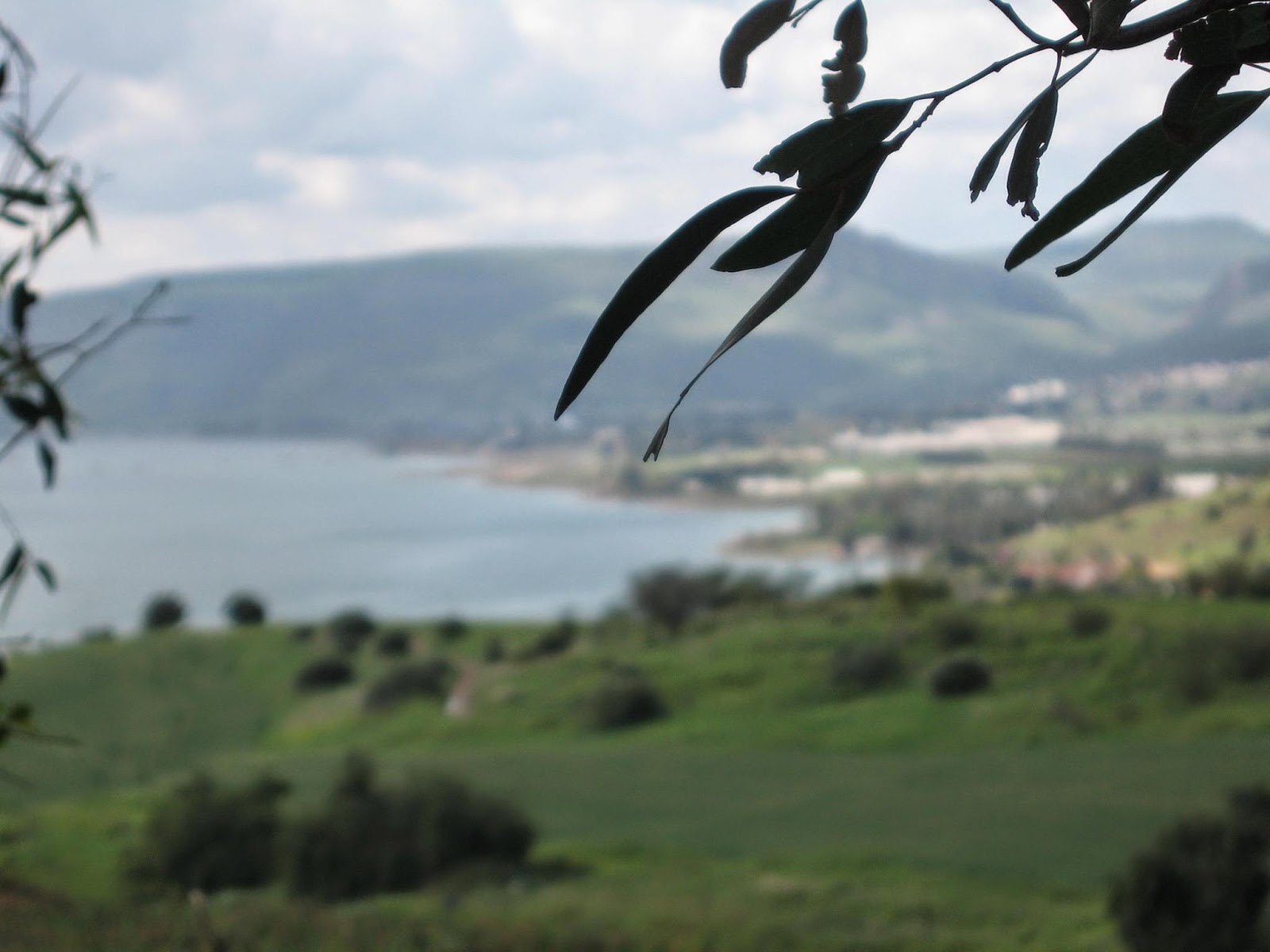
We began Day 3 of our adventure sailing across the Sea of Galilee, and the words of this hymn rang in my mind. It was a perfect morning for the sail: sunny, just a bit of a breeze, utterly beautiful, a perfect day to envision the first four disciples – Simon Peter, Andrew, James and John – putting down their nets and following Jesus. Viewed an actual fishing boat dating from the first century. Enjoyed a lunch of cooked fish. Visited the Church of the Beatitudes and the Church of the Multiplication of the Loaves and Fishes. Then on to Capernaum and Caesarea Philippi, and a glimpse across the Syrian border. Full day, and so wonderful. Tomorrow? On to the Jordan River, and making our way to Jerusalem.


erfect morning for the sail: sunny, just a bit of a breeze, utterly beautiful, a perfect day to envision the first four disciples – Simon Peter, Andrew, James and John – putting down their nets and following Jesus. Viewed an actual fishing boat dating from the first century. Enjoyed a lunch of cooked fish. Visited the Church of the Beatitudes and the Church of the Multiplication of the Loaves and Fishes. Then on to Capernaum and Caesarea Philippi, and a glimpse across the Syrian border. Full day, and so wonderful. Tomorrow? On to the Jordan River, and making our way to Jerusalem.

Day 4:
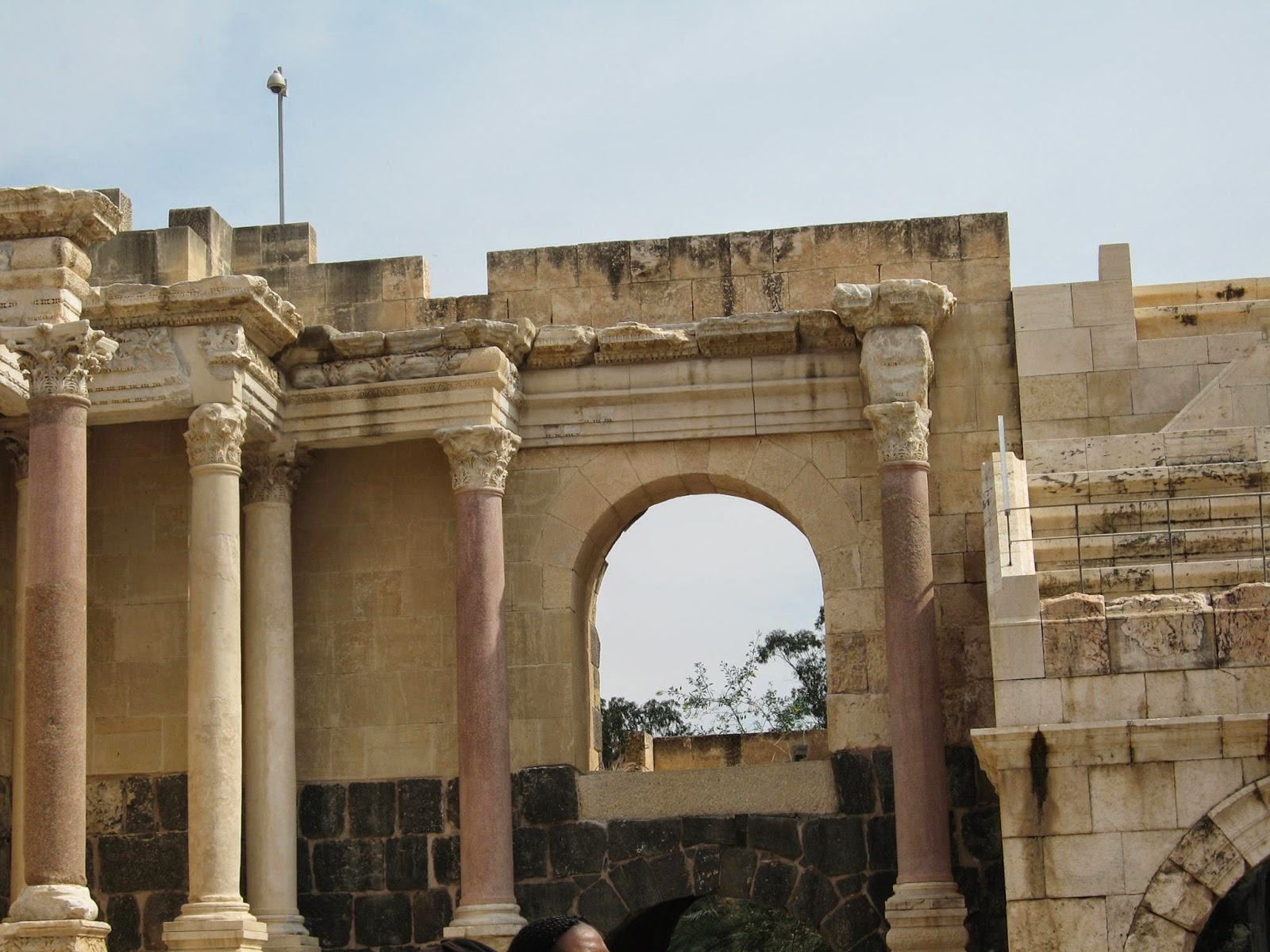
Today began on the Jordan River, where we witnessed several people of different nationalities being baptized. Amazing to hear so many languages being spoken as our shared faith was affirmed. We drove along the Jordan border, stopping at the magnificent ruins of Bet She’an as we made our way into the Judean desert. Near Jericho, we saw shepherds in the hill country, tending their sheep. (And we took time for a little camel-riding fun ourselves!) We made our way into Jerusalem, taking in the magnificent views. A stop at the Mount of Olives was followed by a time of prayer and reflection at the Church of All Nations and the Garden of Gethsemane. The highlight of the day, though, was spending time with my dear friend, Sara’s, beautiful family. Tomorrow? On to the Old City, and the Via Dolorosa.


magnificent ruins of Bet She'an as we made our way into the Judean desert. Near Jericho, we saw shepherds in the hill country, tending their sheep. (And we took time for a little camel-riding fun ourselves!) We made our way into Jerusalem, taking in the magnificent views. A stop at the Mount of Olives was followed by a time of prayer and reflection at the Church of All Nations and the Garden of Gethsemane. The highlight of the day, though, was spending time with my dear friend Sara Benin's beautiful family. Tomorrow? On to the Old City, and the Via Dolorosa.
Day 5:
“So they took Jesus; and carrying the cross by himself, he went out to what is called The Place of the Skull, which in Hebrew is called Golgotha. There they crucified him, and with him two others, one on either side, with Jesus between them. Pilate also had an inscription written and put on the cross. It read, ‘Jesus of Nazareth, the King of the Jews.’ Many of the Jews read this inscription, because the place where Jesus was crucified was near the city; and it was written in Hebrew, in Latin, and in Greek.”
A moving day, making our way with other pilgrims of many other countries and tongues along the Via Dolorosa, ending up at the Church of the Holy Sepulchre, traditionally believed to be the site of Jesus’ Crucifixion, burial and Resurrection. Comparing the arch. Pilate also had an inscription written and put on the cross. It read, ‘Jesus of Nazareth, the King of the Jews.’ Many of the Jews read this inscription, because the place where Jesus was crucified was near the city; and it was written in Hebrew, in Latin, and in Greek.”

A moving day, making our way with other pilgrims of many other countries and tongues along the Via Dolorosa, ending up at the Church of the Holy Sepulchre, traditionally believed to be the site of Jesus' Crucifixion, burial and Resurrection. Comparing the archaeological evidence from the more recently recognized Garden Tomb. Experiencing the confluence of cultures – Jewish, Christian and Muslim – in the sights, sounds and smells of the Old City. Tomorrow? To Bethlehem
aeological evidence from the more recently recognized Garden Tomb. Experiencing the confluence of cultures – Jewish, Christian and Muslim – in the sights, sounds and smells of the Old City. Tomorrow? To Bethlehem.


Day 6:
“In those days a decree went out from Emperor Augustus that all the world should be registered. This was the first registration and was taken while Quirinius was governor of Syria. All went to their own towns to be registered. Joseph also went from the town of Nazareth in Galilee to Judea, to the city of David called Bethlehem, because he was descended from the house and family of David. He went to be registered with Mary, to whom he was engaged and who was expecting a child. While they were there, the time came for her to deliver her child. And she gave birth to her firstborn son and wrapped him in bands of cloth, and laid him in a manger, because there was no place for them in the inn.”
Much to take in today in Bethlehem...Crossing a barbed-wired, walled border from Jerusalem into this Palestinian-occupied city, and seeing armed militia walking along the streets as we made our way to the Church of the Nativity, I was struck that the world which now surrounds the stable-place is probably not much different than the world into which the Son of God was born. And, a moving visit to Yad Vashem, Israel’s Holocaust Museum, offered another sobering reminder of the atrocities that humans have committed against one another. Prayer time at the Wailing Wall this evening became a fitting close for this emotional day. Tomorrow? Off to the Dead Sea.


Day 7:
Qumran and the Dead Sea...even though I've known the story of the Dead Sea Scrolls, seeing the area is incredible. Grateful for the faithfulness of the Essenes to preserve the ancient writings for future generations and for the perseverance and care of those who brought them to light.


Wrapping up:
“The angel said to her, ‘The Holy Spirit will come upon you, and the power of the Most High will overshadow you; therefore the child to be born will be holy; he will be called Son of God. And now, your relative Elizabeth in her old age has also conceived a son; and this is the sixth month for her who was said to be barren. For nothing will be impossible with God.’ Then Mary said, ‘Here am I, the servant of the Lord; let it be with me according to your word.’ Then the angel departed from her.”

There could be no more fitting end to this journey than to visit the Church of John the Baptist and the Church of the Visitation of Mary and Elizabeth. Mary and Elizabeth are the image of hope and expectation, and possibility in the face of impossibility. Elizabeth’s son, John the Baptist, born to her in her old age, would obey the call of God to go out into the world and prepare the way for the coming of God’s Son. And that Son, born to the Virgin Mary, would heal the sick, feed the hungry, teach the lost and give hope to the hopeless before giving up his own life on a cross. May we all be encouraged by Mary and Elizabeth’s faithfulness; may we all be strengthened by their courage. May we all find possibility in the face of impossibility – through God, who makes all things possible. Let it be with all of us, according to God’s holy word.


ent from the town of Nazareth in Galilee to Judea, to the city of David called Bethlehem, because he was descended from the house and family of David. He went to be registered with Mary, to whom he was engaged and who was expecting a child. While they were there, the time came for her to deliver her child. And she gave birth to her firstborn son and wrapped him in bands of cloth, and laid him in a manger, because there was no place for them in the inn.”

Much to take in today in Bethlehem…Crossing a barbed-wired, walled border from Jerusalem into this Palestinian-occupied city, and seeing armed militia walking along the streets as we made our way to the Church of the Nativity, I was struck that the world which now surrounds the stable-place is probably not much different than the world into which the Son of God was born. And, a moving visit to Yad Vashem, Israel’s Holocaust Museum, offered another sobering reminder of the atrocities that humans have committed against one another. Prayer time at the Wailing Wall this evening became a fitting close for this emotional day. Tomorrow? Off to the Dead Sea.