Friday, May 9, 2014

A Pilgrim’s Reflections, from a first trip to the Holy Land....

Day 2:
A pic of the day, from the Basilica of the Annunciation, in Nazareth. Definitely more pix to come. Arrival yesterday in Tel Aviv (Day 1), and a long walk along the Mediterranean before dinner. Today, traveled north to Caesarea Maritima, on to the Monastery of the Carmelites, then to Megiddo, before heading into Galilee. Not nearly enough time in Nazareth before making our way to Tiberias this evening. Tomorrow? On to the Sea of Galilee.onastery of the Carmelites, then to Megiddo, before heading into Galilee. Not nearly enough time in Nazareth before making our way to Tiberias this evening. Tomorrow? On to the Sea of Galilee.


Day 3:
They cast their nets in Galilee,
just off the hills of brown,
such happy simple fisherfolk
before the Lord came down.

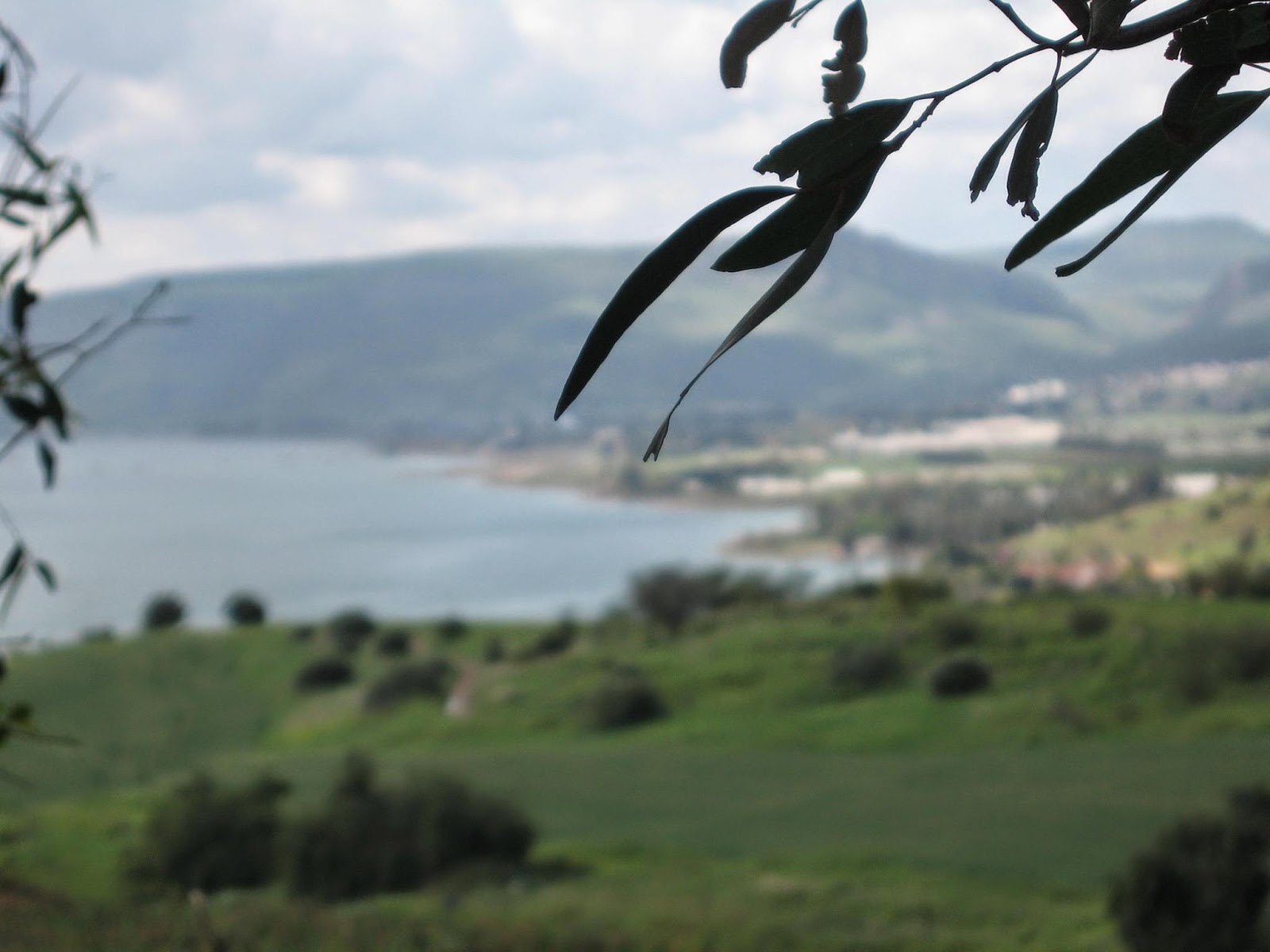
We began Day 3 of our adventure sailing across the Sea of Galilee, and the words of this hymn rang in my mind. It was a perfect morning for the sail: sunny, just a bit of a breeze, utterly beautiful, a perfect day to envision the first four disciples – Simon Peter, Andrew, James and John – putting down their nets and following Jesus. Viewed an actual fishing boat dating from the first century. Enjoyed a lunch of cooked fish. Visited the Church of the Beatitudes and the Church of the Multiplication of the Loaves and Fishes. Then on to Capernaum and Caesarea Philippi, and a glimpse across the Syrian border. Full day, and so wonderful. Tomorrow? On to the Jordan River, and making our way to Jerusalem.


erfect morning for the sail: sunny, just a bit of a breeze, utterly beautiful, a perfect day to envision the first four disciples – Simon Peter, Andrew, James and John – putting down their nets and following Jesus. Viewed an actual fishing boat dating from the first century. Enjoyed a lunch of cooked fish. Visited the Church of the Beatitudes and the Church of the Multiplication of the Loaves and Fishes. Then on to Capernaum and Caesarea Philippi, and a glimpse across the Syrian border. Full day, and so wonderful. Tomorrow? On to the Jordan River, and making our way to Jerusalem.
Day 4:
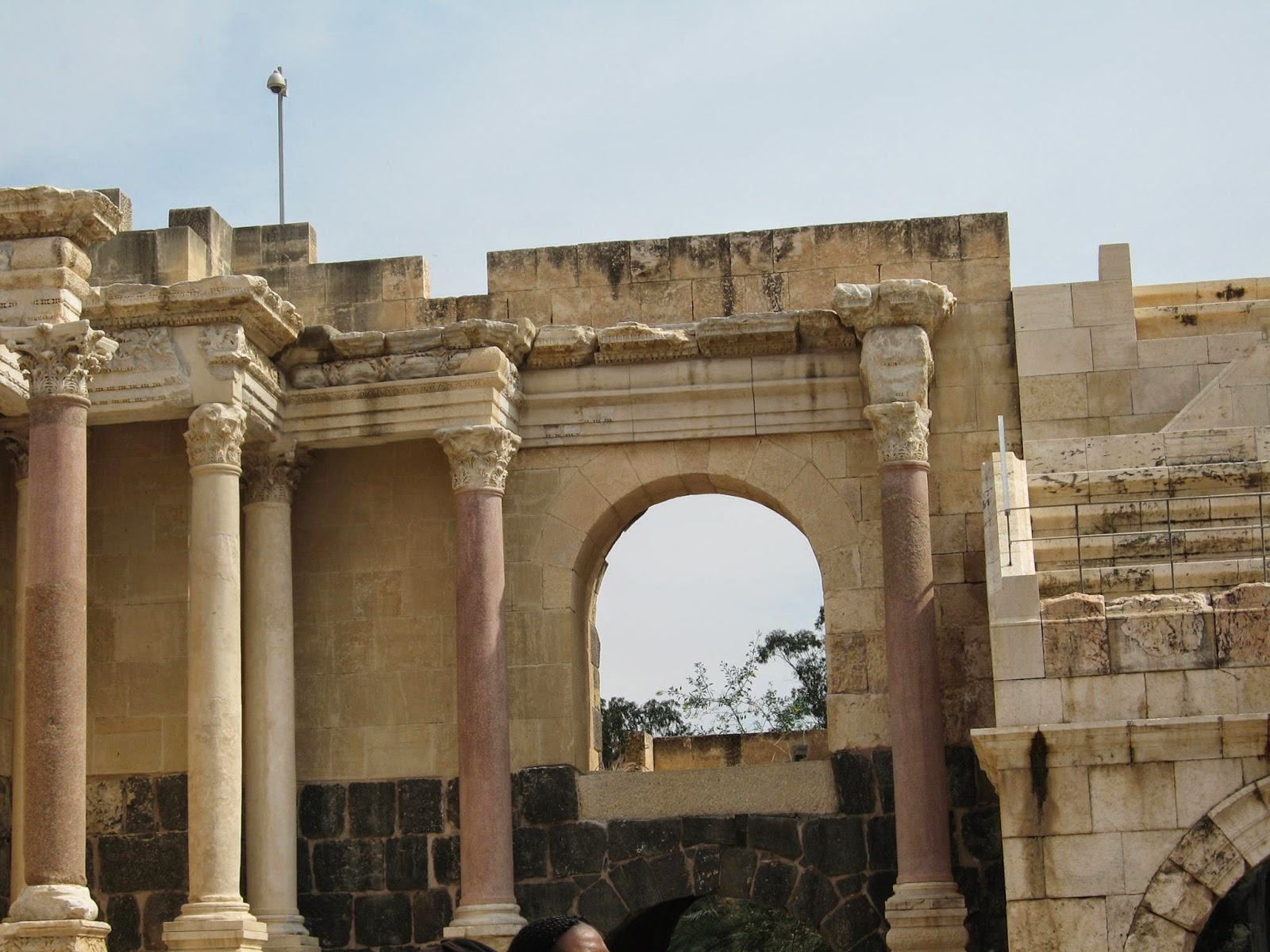
Today began on the Jordan River, where we witnessed several people of different nationalities being baptized. Amazing to hear so many languages being spoken as our shared faith was affirmed. We drove along the Jordan border, stopping at the magnificent ruins of Bet She’an as we made our way into the Judean desert. Near Jericho, we saw shepherds in the hill country, tending their sheep. (And we took time for a little camel-riding fun ourselves!) We made our way into Jerusalem, taking in the magnificent views. A stop at the Mount of Olives was followed by a time of prayer and reflection at the Church of All Nations and the Garden of Gethsemane. The highlight of the day, though, was spending time with my dear friend, Sara’s, beautiful family. Tomorrow? On to the Old City, and the Via Dolorosa.


magnificent ruins of Bet She'an as we made our way into the Judean desert. Near Jericho, we saw shepherds in the hill country, tending their sheep. (And we took time for a little camel-riding fun ourselves!) We made our way into Jerusalem, taking in the magnificent views. A stop at the Mount of Olives was followed by a time of prayer and reflection at the Church of All Nations and the Garden of Gethsemane. The highlight of the day, though, was spending time with my dear friend Sara Benin's beautiful family. Tomorrow? On to the Old City, and the Via Dolorosa.
Day 5:
“So they took Jesus; and carrying the cross by himself, he went out to what is called The Place of the Skull, which in Hebrew is called Golgotha. There they crucified him, and with him two others, one on either side, with Jesus between them. Pilate also had an inscription written and put on the cross. It read, ‘Jesus of Nazareth, the King of the Jews.’ Many of the Jews read this inscription, because the place where Jesus was crucified was near the city; and it was written in Hebrew, in Latin, and in Greek.”
A moving day, making our way with other pilgrims of many other countries and tongues along the Via Dolorosa, ending up at the Church of the Holy Sepulchre, traditionally believed to be the site of Jesus’ Crucifixion, burial and Resurrection. Comparing the arch. Pilate also had an inscription written and put on the cross. It read, ‘Jesus of Nazareth, the King of the Jews.’ Many of the Jews read this inscription, because the place where Jesus was crucified was near the city; and it was written in Hebrew, in Latin, and in Greek.”

A moving day, making our way with other pilgrims of many other countries and tongues along the Via Dolorosa, ending up at the Church of the Holy Sepulchre, traditionally believed to be the site of Jesus' Crucifixion, burial and Resurrection. Comparing the archaeological evidence from the more recently recognized Garden Tomb. Experiencing the confluence of cultures – Jewish, Christian and Muslim – in the sights, sounds and smells of the Old City. Tomorrow? To Bethlehem
aeological evidence from the more recently recognized Garden Tomb. Experiencing the confluence of cultures – Jewish, Christian and Muslim – in the sights, sounds and smells of the Old City. Tomorrow? To Bethlehem.


Day 6:
“In those days a decree went out from Emperor Augustus that all the world should be registered. This was the first registration and was taken while Quirinius was governor of Syria. All went to their own towns to be registered. Joseph also went from the town of Nazareth in Galilee to Judea, to the city of David called Bethlehem, because he was descended from the house and family of David. He went to be registered with Mary, to whom he was engaged and who was expecting a child. While they were there, the time came for her to deliver her child. And she gave birth to her firstborn son and wrapped him in bands of cloth, and laid him in a manger, because there was no place for them in the inn.”
Much to take in today in Bethlehem...Crossing a barbed-wired, walled border from Jerusalem into this Palestinian-occupied city, and seeing armed militia walking along the streets as we made our way to the Church of the Nativity, I was struck that the world which now surrounds the stable-place is probably not much different than the world into which the Son of God was born. And, a moving visit to Yad Vashem, Israel’s Holocaust Museum, offered another sobering reminder of the atrocities that humans have committed against one another. Prayer time at the Wailing Wall this evening became a fitting close for this emotional day. Tomorrow? Off to the Dead Sea.


Day 7:
Qumran and the Dead Sea...even though I've known the story of the Dead Sea Scrolls, seeing the area is incredible. Grateful for the faithfulness of the Essenes to preserve the ancient writings for future generations and for the perseverance and care of those who brought them to light.


Wrapping up:
“The angel said to her, ‘The Holy Spirit will come upon you, and the power of the Most High will overshadow you; therefore the child to be born will be holy; he will be called Son of God. And now, your relative Elizabeth in her old age has also conceived a son; and this is the sixth month for her who was said to be barren. For nothing will be impossible with God.’ Then Mary said, ‘Here am I, the servant of the Lord; let it be with me according to your word.’ Then the angel departed from her.”

There could be no more fitting end to this journey than to visit the Church of John the Baptist and the Church of the Visitation of Mary and Elizabeth. Mary and Elizabeth are the image of hope and expectation, and possibility in the face of impossibility. Elizabeth’s son, John the Baptist, born to her in her old age, would obey the call of God to go out into the world and prepare the way for the coming of God’s Son. And that Son, born to the Virgin Mary, would heal the sick, feed the hungry, teach the lost and give hope to the hopeless before giving up his own life on a cross. May we all be encouraged by Mary and Elizabeth’s faithfulness; may we all be strengthened by their courage. May we all find possibility in the face of impossibility – through God, who makes all things possible. Let it be with all of us, according to God’s holy word.


ent from the town of Nazareth in Galilee to Judea, to the city of David called Bethlehem, because he was descended from the house and family of David. He went to be registered with Mary, to whom he was engaged and who was expecting a child. While they were there, the time came for her to deliver her child. And she gave birth to her firstborn son and wrapped him in bands of cloth, and laid him in a manger, because there was no place for them in the inn.”

Much to take in today in Bethlehem…Crossing a barbed-wired, walled border from Jerusalem into this Palestinian-occupied city, and seeing armed militia walking along the streets as we made our way to the Church of the Nativity, I was struck that the world which now surrounds the stable-place is probably not much different than the world into which the Son of God was born. And, a moving visit to Yad Vashem, Israel’s Holocaust Museum, offered another sobering reminder of the atrocities that humans have committed against one another. Prayer time at the Wailing Wall this evening became a fitting close for this emotional day. Tomorrow? Off to the Dead Sea.

Wednesday, April 30, 2014

How Much Longer Will We Look the Other Way?


So, let me get this straight.

Donald Sterling, the 80-year-old owner of the L.A. Clippers, happens to be recorded (How convenient…?) as he tells his “girlfriend” that he really wishes that she wouldn’t be photographed with black people or bring them to Clippers games.

And when this highly-contrived and conveniently recorded (By the way, who put her up to that…?) conversation is leaked to the media, we, the public, feign surprise that there are people – yes, even high profile people – in the world who harbor and espouse racist beliefs.

Well, please allow me to make an observation: Racists do live among us. And, if I might, please allow me to make one more: The racists who live among us come in all colors, all shapes, all sizes, all ages. We can find them in any walk of life; they may pursue any vocation, live in any neighborhood, or claim to be adherents of any faith. They may be pillars of the community, yes, even wealthy 80-year-old basketball team owners who have received awards for their contributions to the community.

Of course, some may argue, in hindsight, that allegations of Sterling’s discrimination in his property leasing business should have been a clue to his true disposition. But those allegations didn’t spur us to ask questions or urge him to change any of his business practices.  We simply looked the other way.

Too often, we all simply ignore the behavior of those who harbor intolerant attitudes. We shrug at unsavory comments, or smile uncomfortably at tasteless jokes. We fail to speak up when we see blatant acts of discrimination. We continue to patronize business establishments that have lengthy histories of discriminatory practices.

Many years ago, I went to one of Memphis’ iconic barbeque restaurants with a date. We arrived, were seated, and waited for one of the servers to take our order.

We waited, and waited.

And we couldn’t help noticing that folks at all of the tables around us were being warmly greeted by the restaurant’s servers, served promptly, and given great attention….all while we waited for someone to even take our order.  When a rude server finally brought our meal to the table, our barbeque was cold.

Now, in case you might be wondering, my date from all those years ago is black, as am I. The servers in question? They were all black, too. But all of the folks seated around us that evening were all white.

The experience left a bad enough taste in my mouth (no pun intended) that I avoided this particular restaurant for quite some time – years, in fact. The next time that I was there, I happened to be with a mixed-race group of co-workers from my office. And our service couldn’t have been better, our server couldn’t have been chattier, and our food couldn’t have been tastier.

But when my husband and I gave the place a try a few years later, we discovered that nothing had changed from my first experience there. Our service was slow, our server was rude, our food was cold, and others around us were receiving far better service. And we gave the place another chance, just in the past few years, just to see if we had, by chance, previously happened in on a bad evening. No such luck.  I have no plans to return.

The point of this story is simple: When the business principles of a particular establishment offended me, I made a decision that I wouldn’t continue to patronize the establishment. Now, granted, this establishment doesn’t seem to have missed my patronage; it continues to be a thriving place. But I will choose only to support businesses that treat me and others with respect.

If Donald Sterling’s business practices offended us all that way – if players wouldn’t play for him, if coaches wouldn’t coach for him, if fans chose to spend their entertainment dollars with that other L.A. team – it might well be that Donald Sterling would have been out of the business of basketball already, without any further encouragement.

But his behavior hasn’t offended us that way. And it's almost as if we secretly hope that someone like NBA Commissioner Adam Silver will come along and do what we don’t have the collective fortitude to do – even if (and I do question this…) Silver’s proposed punishment may not be legal.

The Adam Silvers of the world cannot save us from ourselves. If we truly want to bring about change, we must stop looking the other way. We all must be willing to acknowledge acts of racism and intolerance when we see them, speak up in support of those who are being oppressed, reprove in love our brothers and sisters who fail to love all of God’s people, and, yes, refuse to support business establishments and institutions whose leaders fail to respect the dignity of every human being.

One of the best commentaries that I’ve seen on this sad tale was written by retired basketball-great Kareem Abdul-Jabbar, who ends his eloquent writing with these words: “Instead of being content to punish Sterling and go back to sleep, we need to be inspired to vigilantly seek out, expose, and eliminate racism at its first signs.”

Thank you, Kareem. I couldn’t have said it better myself.


Tuesday, March 4, 2014

Forgive....and be forgiven....


When I was a freshman in high school, another student at my school tried to stab me.

I honestly can’t say that I understand why “Sharon” wanted to hurt me. I really didn’t know her, but I knew that she struggled in school, and I knew that she hung around a pretty tough group of girls who seemed to enjoy bullying others. Now, granted, I was pretty much the quintessential nerd kid – and nerd kids seem to be a magnet for bullies. But I’d had no particular encounters with “Sharon” that would have provoked her to want to hurt me.

On a Friday in April, “Sharon” came to school with a large kitchen knife hidden in her books. And as I walked down the hallway with a friend between classes, oblivious to what was happening, she tried to stab me. God’s grace – and the quick action of a couple of upper classmen boys who saw the knife just before it would otherwise have been plunged into my back – spared me that day. Her angry, expletive-filled tirade as the boys wrestled the knife from her only confused me more and fed my sense of bitterness and hurt that she could want to harm me.

I have no idea what happened to “Sharon.” She was suspended from school for the remainder of that school year, and given that she was already struggling and not allowed to take final exams, she was held back the following school year. The next fall, I saw her in the hallways from time to time, but admittedly still frightened, I steered clear of her; after a while, I never saw her again. My guess was that, like too many other students who have learning challenges and who lack solid support, she just gave up. As for me, I’d wanted to transfer to another school, as frightening as the whole episode had been, but my mother wasn’t similarly inclined to abandon the school’s stellar academic program. I stayed, I continued to thrive, and in time, I pretty much shrugged the whole thing off.

As I’ve grown older, I have wondered: What might have happened if, after Sharon had come back to school, I had walked up to her, and just said hi? Or invited her to eat lunch with me and my friends? Or simply told her, “I know you don’t like me, and I’m really not mad about what happened.” Might anything have been different? Might knowing that one kid whom she’d bullied saw value in her and was willing to show kindness to her have made a difference in her life – or mine? But I did nothing, because, truth be told, not only was I still frightened, I hadn’t forgiven her for wanting to hurt me, and for taking my sense of safety away. I had allowed fear, anger and hurt to infect me, and nothing could break through the coat of armor that I had forged for protection.

On our best days, forgiving those who have wronged us can be a hard thing to do. We want those who have wronged us to pay; we want our revenge, even when we want desperately to be able to forgive if for no other reason than to rid ourselves of the anger and bitterness that we feel. But as important as it is for us to be forgiving people, we may not realize how important it is for those who have wronged us to know that they are forgiven – wholly and unconditionally – and that we invite them into reconciliation and new relationship.

After a distraught Charlie Roberts took the lives of five Amish schoolgirls before taking his own life in Lancaster County, Pennsylvania in October, 2005, his grief-stricken family experienced an outpouring of love and support from their Amish neighbors. As they mourned their own dead, the Amish families visited the Roberts family to mourn with them and share their grief, and stood with them at Charlie’s funeral. A member of the Amish community told reporters that the Amish had no alternative: They were called to forgive just as God had forgiven them. For the Roberts family, the forgiveness and acceptance that they experienced helped sustain them during the dark days that they faced.

I’ll never know if a kind word to “Sharon” would have made any difference in her life. But I believe that it would have made a profound difference in my life to forgive her – to be able to try to forgive another just as God forgives us all. And, I suspect, one of the keys to healing the divisions in our world may well be for all of us to be people who forgive one another as we are all forgiven by God – and for all of us to experience God’s love and mercy through the forgiveness of those we have wronged.

Tuesday, September 24, 2013

Working on being a better patient.....


I have never been a very good patient.

This level of self-awareness is not new to me. 

No one enjoys being sick, but I may well be a bit more recalcitrant than most. Part of that is because I’m pretty active; being sick means that I necessarily have to interrupt my active routine. Part of it is because I’ve spent lots of time being a caregiver; being a care-receiver is still somewhat awkward for me. And, part of it is that I like to enjoy my down time, which is rather hard to do when one is feeling terrible. 
 
And so, on Sunday, when I got a little too warm in the middle of our worship service (Okay…maybe more than a little…layers of vestments do produce quite a bit of heat…), and a couple of wonderful physicians in our parish were giving me very worried looks – one insisting that a visit to the  emergency room was in order because my heart rate was a bit high (Well, yes, I’m sure my heart was racing, since we actually stopped the service for my little “episode.” How do you spell, EMBARRASSED?!) – I was not pleased about the prospect of being a patient, but I was compliant. If something really were wrong, I didn’t want my own stubborn refusal to be a cooperative patient to lead to my demise.

So off we went to the ER.

I learned a very important lesson: Never walk into an ER and say the word “heart” in any context unless you are actively having a heart attack. Never. Really.

If you say the word “heart” and you are not actually having a heart attack, you may well have one by the time the dedicated medical professionals get done putting you through your paces: EKGs, chest x-rays, blood work, and goodness knows what else. My husband and our younger daughter observed that every time members of this outstanding medical team came in to ask me about my chest pains (Huh? I never said anything about chest pains!), my heart rate would climb all over again.  And since all of this excitement kept my heart rate up for quite some time, the next thing I knew, a cardiologist (who, by the way, was absolutely wonderful) was standing over me suggesting a heart catheterization the next morning as a precaution.

And that meant, of course, that I was staying overnight. In a hospital. Something that I’d only previously done when I gave birth to our two daughters. All because I got a bit too hot and used the word “heart” (as in heart rate, not heart attack) when I came in.
 
I settled in for the night, but all of the attention I received didn’t exactly allow for a restful sleep.  Someone needed to draw more blood, someone else needed to check my vital signs, someone else needed to adjust the leads on the heart monitor that I had to wear all night.
 
When morning came, the great cardiologist was back, still thinking that the precautionary heart cath was a good idea. My husband and I nodded. What else could we do? He sent a quick text message to update our daughters, as the nurse dispensed my “relaxation” meds and hurried me off to the cath lab.

Thankfully, all of my test results were normal, and the heart cath turned up nothing other than a perfectly healthy heart – for which I am grateful. I managed to sleep rather peacefully all day…even though my “relaxation” meds really weren’t supposed to have that effect.  The nurse realized well into the afternoon, when I was still sleeping away, that she’d given me the “standard” dosage that she gave all of her cath patients – without double-checking my weight. After telling my husband that I probably only needed half the dose that she’d given me, she suggested that he keep an eye on me, as I might be a bit drowsy for a while. She wasn’t kidding…

I made it home after the great adventure, and will be staying put…for a couple of days, since I can’t drive yet post-cath. Day one has been filled with reading, prayer, and playing with the dog. Day two will likely look the same.
 
And life will begin to get back to normal by day three, when I can climb back behind the wheel of my Volvo and head back to the office…with a clean bill of health, a desk full of work – and profound thanks to everyone for all of the wonderful phone calls,  texts, emails, Facebook messages, meals, visits, prayers and loving thoughts that you’ve sent my way.  I’m really, really fortunate to have such loving friends – and such wonderful, caring physicians in our parish church.

But I will head back to “normal” taking nothing about being healthy for granted. I am well aware that the outcome of my little adventure could have been much different.

Today, I’m really working on being a better patient. These couple of days of being a quiet patient probably couldn’t have come at a better time.

And, hopefully, when these few days of being a patient are over, I'll retain the lessons of quiet and stillness that have been such wonderful gifts.
 
I hope, too, that my lunch-buddies will still indulge me in agreeing to lunch spots that have great salads…I’m still planning on eating healthy and pounding the pavement every day, for as long as I can.

As amazing as the medical team was, I’d really like to delay another trip to the hospital as a patient for as long as possible…..!

Monday, September 16, 2013

Surely, doors aren't still closed to some at University of Alabama...?


Me...and my sisters...at Rhodes College...


I really don’t want to believe it.

I really don’t want to believe that doors are still being closed to students of color at the University of Alabama.

Yet that’s exactly what major news outlets are alleging: Sixteen “traditionally white” sororities are said to have refused to extend membership invitations to young African-American women at the university during this year’s rush week.

I really don’t want to believe it.

Not in my home state. Not at the “jewel school.” Not in 2013, fifty long years after then-Governor George Wallace used his own body to close the university’s door to prevent African American students from entering.

And certainly not when one of those sixteen “traditionally white” sororities happens to be my own, and when the women inside that house are my sisters – members of Alpha Omicron Pi.

This is why I really don’t want – can’t bring myself – to believe this story: because I know that on college campuses across the country, young African American women are today – and have been for many years – pledging AOII and many of the rest of these sororities, and experiencing these lifelong bonds of friendship and sisterhood.

I really don’t want to believe this story because on the campus of my alma mater, Rhodes College, even over thirty years ago, young African American women, Jewish women, and women of Asian descent have been welcomed into Greek life.  

I really don’t want to believe this story because I am one of those women who found no door closed at Rhodes College.

Although I had no idea what my prospects might be, at the time that I went through rush on the Rhodes campus, I was fortunate enough (naïve enough...!) to have had no concept of just how unusual it might be for a “traditionally white” sorority to extend a membership invitation to a young woman of color…that is, until “bid night,” when a girl from my home town, who was pledging another sorority, came up to me in the happy mayhem around “sorority row,” hugged me, and told me just how special I must be to have been offered a bid at my "first choice" house.

In that instant, I knew. And the value in my eyes of my new sisters, who were welcoming me, a Jewish woman and a woman of Chinese descent into their house, went up exponentially.

Today, my heart is breaking over allegations that beautiful, talented, young African American women were turned away from sororities at University of Alabama,  told that they were unwanted, told that they were less than desirable.  It isn't true.

I’d like to be able to hug all of the young women who have experienced this disappointment and tell them not to allow this one horrible moment to define their lives or make them believe for even one moment that they are second-class citizens.  I’d like to beg them not to let this one rejection to cause them to lose faith in the goodness of God’s people in the world.

For today, I need to believe something more than these allegations.  I really need to believe that, should I visit the University of Alabama campus, I would be welcome in the AOII house.  I really need to believe that, should our daughter decide to attend University of Alabama, she would be welcomed not only into the AOII house, but any other house that she might decide to pledge.

I really need to believe that no more doors will ever be closed to students of color at the University of Alabama, or any other college or university.

Please, O Lord, let it be so.


Thursday, August 29, 2013

Still Dreaming After Fifty Years....


The March on Washington, 1963


Fifty years.
 
Fifty years since a turning point in the 1960s Civil Rights Movement: the historic March on Washington, D.C., where the late Rev. Dr. Martin Luther King, Jr. shared his dream for a new America.
 
This 50th anniversary has struck a particular chord with me, perhaps because I’ve now reached that half-century mark myself.  In some ways, it’s hard for me to grasp just how much has happened in fifty years: The desegregation of public school systems, colleges and universities means that students of color need no longer be escorted into classrooms by federal marshals, or fear government officials barring their entry. Employers can no longer patently refuse to hire employees on the basis of race. Business establishments cannot openly refuse to admit or serve persons of color.
 
So much has happened in fifty years.
 
I and many other persons of color have come of age in a post-Brown v. Board of Education/post-Civil Rights Act of 1964/post-Voting Rights Act of 1964 world that has allowed us all to take much for granted. For us, schools have always been desegregated, Holiday Inns have always been hospitable places to stay during family vacations and no stores or restaurants have ever been off-limits.  But before there were laws that would come to shake our nation’s conscience and make it possible for us to have those experiences, there were many “dreamers,” black and white, men and women, Christian and Jewish, who marched, protested, endured beatings and jail, and gave their lives, all because they dared to believe that all people should enjoy the legal freedom and protections that before had only been available to some.  Those “dreamers” and their sacrifices made it possible for me and for many others to know a world in which there were far more opportunities and far fewer barriers. 
 
Fifty years later, our nation has many achievements to celebrate, but as we do so, we should be mindful to honestly acknowledge our struggles. Too many of our nation’s urban public schools are still segregated – now, filled with students of color.  Too many families of color live in poverty.  Too many young people of color, lured by empty promises of money and status, become trapped in the criminal justice system.  The lives of too many persons of color – especially young men – are lost to violence.
 
Yes, we’ve come a long way. 
 
But we still have a long way to go, to eradicate our fear of those who are “different” – in race, ethnicity, gender or religion – and to overcome our struggle to see ourselves in our neighbors.
 
Laws can mandate that access to schools cannot be denied to persons on the basis of race or ethnicity. But laws alone cannot eliminate cliques, taunting, intimidation, bullying and acts of violence committed against those who are “different” in those schools.
 
Laws can mandate that jobs cannot be denied to persons on the basis of race, ethnicity or gender. But laws alone cannot break glass ceilings to allow women and persons of color to occupy coveted positions of leadership.
 
Laws can mandate that access to public accommodations cannot be denied to persons of color. But laws alone cannot prevent racial and ethnic profiling and targeting that reduce persons of color to second-class citizens once they are admitted to those places of accommodation.
 
Laws can only mandate so much.
 
And where the letter of the law stops, I believe that the work of all of God’s people must continue – in transforming hearts and lives – so that we, like the dreamers before us, can envision a world in which we meet those whose skin is a different color without suspicion, in which we greet our neighbors whose native tongues differ from our own without fear, and in which we encounter those whose religious beliefs differ from our own without apprehension.
 
My great-grandfather – a man born into slavery, a man who could neither read nor write – began a school on his Homestead so that his descendants would have educational opportunities that had not been available to him. As one who dared to stand up to the establishment of the late 1800s and demand to be counted as a man, I am certain that he would be cheering proudly now at the world in which his descendants live.
 
And, no doubt, he would remind us that, as a nation, we’ve come too far in the past fifty years to stop dreaming now.


Wednesday, July 17, 2013

On Trayvon Martin, George Zimmerman, and loving our neighbors as ourselves....


My heart hurts.

In the aftermath of the George Zimmerman trial and verdict, my heart hurts. 

My heart hurts for Trayvon Martin and for his family; I cannot imagine their pain and grief.

My heart hurts for those who mourn the verdict, and for all those who feel that the criminal justice system has failed them.

My heart hurts for our family members, our friends and all families of color who feel an even greater sense of fear as their sons go about their lives and who, because of this verdict, find themselves explaining to them – yet again – that they must never give anyone even an iota of a reason to harass or hurt them and how careful they must be if they ever find themselves in a similar kind of confrontation.

My heart hurts, too, for George Zimmerman, and for his family. Zimmerman may have been acquitted, but he is not a free man. Whatever his motivations, whatever thoughts may have been running through his mind as he jumped from his car to confront Trayvon Martin, he now lives with that young man’s blood on his hands and in fear for his own safety. 

My heart hurts for those who have taken to social media to rejoice in the verdict, as well as for those who spout venomous threats against Zimmerman.

My heart hurts for those who harbor anger, hatred and bitterness, on either side.

My heart hurts for our country – and for the seemingly widening gulf that divides us.

My heart hurts.

Call it a “God thing” that many Christians all over our country whose denominations follow common Scripture readings were hearing the “Good Samaritan” text from Luke’s Gospel in their churches on Sunday morning, just hours after the verdict was handed down.  Call it a “God thing” that millions of Christians were hearing again an all-too-familiar story from Jesus in which a man is traveling on the road from Jerusalem to Jericho when he is attacked by robbers, beaten and left for dead. Two holy men, a priest and a Levite, see the injured man but cross the road to avoid coming near him. But a man from Samaria comes upon the injured man, and stops to care for him.

A Samaritan? Why a Samaritan? His inclusion certainly makes the story more challenging for Jesus’ audience.  Samaritans were – to put it bluntly – a hated race.  It’s likely that a Samaritan would have been called a few names in his lifetime, endured more than a few demeaning gestures, been shunned and cast aside on more than one occasion.  No one listening to this parable would have been surprised if the Samaritan had been the one to cross the road to avoid the injured man; he would have had good reason. Yet it is the Samaritan who takes note of the injured stranger, cares for the man’s wounds, picks him up, puts him on his own animal, and takes him to a safe place where he can recover.

Call it a “God thing” that many Christians were being reminded on Sunday of the commandment that we are to love our neighbors as ourselves.

That’s often as tough a message for us to hear today as it was for people in the first century world. It’s too easy to fear those who aren’t like us, to avoid those who call us from our comfort zones, to seek revenge against those who wrong us, to hate those who hated us first.

When I was a little girl, we had a wooden ruler in our house – a giveaway from a furniture store, as I recall – which bore the words, “Always follow The Golden Rule: Do unto others as you would have them do unto you.” I remember asking my mother what that meant one day, and she told me, as she would often repeat over the years, “never do anything to someone else that you wouldn’t want that person to do to you.”

There’s no arguing with that sage advice.

But as I’ve matured, I‘ve found that I like re-phrasing that advice in the affirmative: Always do for others what we would have them do for us.  Love the unlovable. Remember the forgotten. Care for the sick. Feed the hungry. Clothe the naked. House the homeless. Welcome the outcast.  And we should do all those things even if those for whom we care hate us.  Even if they would want to have nothing to do with us. Even if they would call us demeaning names or make derogatory gestures. Even – perhaps, especially – if we believe that they can do nothing for us in return.

Yes, my heart hurts.  But I still have hope.  Because of all the people who love unselfishly, I have hope.  Because of all of the people who tirelessly minister to others in a myriad of ways, I have hope. I have hope that the gulf between races and cultures can be narrowed.  I have hope that the Zimmerman verdict can engender respectful dialogue between people who might otherwise have never come to the table together.  And I have hope that one day soon, we will all “stand our ground” by standing together in firm commitment to work for unity, justice and peace.

Wednesday, October 24, 2012

In memory of Sara....


Six years have passed since my dear friend, Sara Benin, lost a valiant and courageous battle with cancer.

I can honestly say that not one day of those six years has passed without me thinking of her…and missing her. 

I think of her smile, her hearty laugh, her wit.  I think of her love for her family.  I think of her care and concern for her friends.  I think of her devotion to her faith.  I think of funny “Sara-isms.”  I think of her sage advice.

I really don’t remember the first conversation that Sara and I had at our old law firm.  Perhaps we shared a laugh about something during a section meeting.  But what likely began as a conversation about work quickly evolved into us sharing stories about our lives – as wives, as mothers, as daughters, as women of faith.  As unlikely as a friendship between an Orthodox Jew who was the daughter of Holocaust survivors and a Christian may have seemed to others, it seemed perfectly natural to us.  We focused on what we had in common, and those ties formed the basis of a wonderful friendship.

We were both only children, both born to older parents, both raised in homes where expectations were great.  We were both deeply rooted in our faith – even if we had lived through periods during which we didn’t realize just how deeply rooted we were.  We loved our families and we loved motherhood; we were amazed by our children.  As much as we both enjoyed our careers as lawyers, we never forgot that we were wives and mothers and daughters first; everything else came a distant second. 

We soon began enjoying more relaxed conversations away from the office.  We planned play dates – at the zoo, at a park, at a carousel at a local mall – where our children could play and we could sneak in a little bit of adult conversation.  Even when we no longer practiced law together, we made it a point regularly to grab lunch at a favorite spot so that we could catch up.

Sara was a brilliant lawyer.  Her sharp mind and grasp of even the most minute details made her a highly-sought-after intellectual property lawyer, to the end.

But Sara was much more than a brilliant lawyer.  She was an amazing friend – a good listener, with a compassionate heart.  She loved life, and she gave unselfishly to others.   For months, she’d visited the bedside of a teacher who had been left comatose from an accident, spending hours nearly each day reading and talking to her. She cared patiently and tirelessly for her own mother, celebrating the joy of hearing her mother call her by a beloved nickname as Alzheimer’s robbed her of her memories. As my parents’ health deteriorated and I struggled with making the best decisions regarding their care, Sara became my sounding board and support.  Even as she endured cancer, Sara’s sunny disposition was contagious.  You couldn’t be around Sara – and her hearty laugh – and be in a bad mood for long.  She had this way of always knowing just what to say.   

And as much as I missed Sara when she and her family moved to Jerusalem, she was never far away.  Her emails gave beautiful descriptions of her new home and all that she was discovering each day.  Cancer had neither defined nor limited her.  She was living life to its fullest – taking care of her husband and children, moving her mother to Jerusalem, practicing law from her apartment, experiencing all of the sights and sounds and culture of her new home.   Even from across the world, Sara continued to be a devoted friend and confidant.  We exchanged lengthy emails, and caught up on our face time during her visits back to Memphis.     

To the end, Sara never hesitated to give unselfishly of herself to others. She hadn’t wanted any of us to know just how sick she was during her last visit to Memphis, a couple of months before her death.  Sara had decided that the visit was a time for happy memories, and it was.  We visited.  We laughed.  We talked about children becoming teenagers.  We talked about Jerusalem.  We shared our stories of caring for our parents.  We planned a lunch at our home for some of the female lawyers from our old law firm.  We laughed and talked and laughed some more.  I shared with her my hope that I would get to visit her in Jerusalem; I longed to walk alongside her on the streets of her new home, taking in the sights through her eyes.  Even though the visit for which I hoped just wasn’t to be, I’m still planning to make my way there, with the images from her emails and our conversations embedded in my mind and in my heart. 

Sara’s last email to me, just days before her death, was a message of consolation following my father’s death, just weeks before.  Her beautiful last message to me was one of comfort and reassurance; she reminded me of all that I had done to care for both my parents, and of how very much I was loved.  She wasn’t there to give me a hug, or to take me away for a girls’ day out, she said, but she asked me to spend a day doing something as if we were enjoying it together. 

Just like Sara…always knowing just what to say.

Tuesday, September 18, 2012

On Motherhood, and Our Young Taking Flight...


Bird with nest Stock Photo - 10402765


A few days ago, I had lunch with the mothers of some of our older daughter’s high school classmates.  It was a time to get together to talk about what we’d just experienced; within the past few weeks, we all have taken our daughters off to college.  For some of us, it’s the first child “out of the nest,” and for others, the nest is now empty.

The consensus from our lunch group was this:  No matter how ready our kids are for their independence, no matter how well-prepared we think we are for that day, no matter how excited we are for our teens to have a great college experience, the act of a mother leaving her child in a far-away (or not so far-away) place is gut-wrenching.

No one prepares you for this moment when you are holding your newborn in your arms.  Or when you’re reading your toddler the tenth bedtime story of the evening.  Or when you’re sitting up with your sick child all night.  Or when you’ve been at the soccer field, the pool or the volleyball court for hours on end, watching your child and her team.  Or when you’re struggling to be patient as you help your teen learn to drive.  You are there, right there with your child, keeping her safe.

In reality, no one can prepare you for this moment.  One mother shared that, as she and her husband began the drive home from the “drop off,” she told him that she felt that she’d just lost her job.  That nurturing job.  That wiping teary eyes and runny noses job.  That kissing boo-boos and doctoring skinned knees job.  That baking cookies and doing laundry job.  That listening and all-too-often having to bite your tongue job. That being right there to catch you when you fall job.

It’s a job that we inevitably have to lose, that is, if we’ve done it well.  After all, we’re here to help our children become confident, self-sufficient, capable, morally-responsible – and independent – adults.

But that doesn’t make the separation any easier.

I didn’t appreciate that fact when I left home for college – way back when.  I happily soared off for what would be an amazing adventure: I encountered inspiring professors who stirred my passion for learning, made lifelong friends, had my first experiences in community service, grew as a leader, and learned more about myself than I ever could have imagined.

It was all good – and the kind of experience that I wish for our daughter. 

But while I soared off without a care in the world, I know now that my mother was still at home being a mother – worrying about me being in a larger city, fretting about the dangers that I might encounter, wondering if I were eating healthy meals, getting enough sleep and keeping up with my coursework. 

But all the while I was fiercely asserting my independence.  I recall now that as I prepared to drive home for my first fall break, I’d expected to leave around 10:00 that morning, and told my parents that I’d be home by 5:00 p.m.  The fellow student from my hometown who was riding home with me realized that he wouldn’t be finished with a test that he was taking until nearly noon, so we got a later-than-expected start.  I could have called my parents to let them know about the delay, but no doubt busy with my new life, I didn’t.

And when I pulled into the driveway just after 7:00 p.m., my mother’s tear-stained face in the kitchen window spoke volumes about motherhood: the worry, the fear, and the undying instinct to protect our young never go away.

And so, I’m hoping that our own fiercely independent daughter – who seems to be adjusting happily and well to college life – will forgive me for worrying, for fretting, for not being able to just kick that mother-job to the curb.  I’m hoping that she’ll know that I’m still there, cheering her on and watching her soar, albeit from a safe distance.

After all, she’s got beautifully-developing new wings to try out, and she needs to be able to soar and enjoy them.